
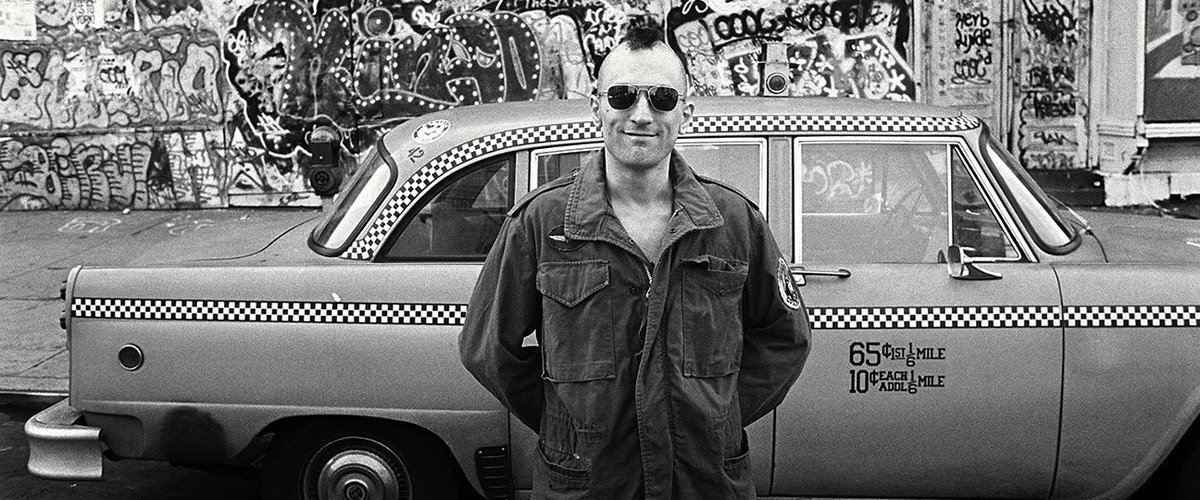
Patricia Patterson and Manny Farber write in “The Power and the Gory: Taxi Driver”:
The fact is that, unlike the unrelentingly presented worm in Dostoevski’s Underground Man, this handsome hackie [Travis Bickle] is set up as lean and independent, an appealing innocent. The extent of his sexism and racism is hedged. While Travis stares at a night world of black pimps and whores, all the racial slurs come from fellow whites. In fact, Travis tries to pick up a mulatto candy seller in an interesting porno-theater scene. He tries to joke with this bored, rather pretty but definitely uninterested popcorn girl who’s reading a fan mag, and she calls the manager. De Niro, giving up quickly and furtively switching to buying candy, creates a telling poetic ambience (Si. 87: “gimme some Chuckles … and some jujus, they last longer … some pop- corn and some Coke”).
There’s dubious indication that the cabbie is a woman-hater, but the film is a barrage of cheapened sex washing over a graceful nobody who is basically a receiver rather than a giver. It’s not Travis who talks about blowing a woman’s pussy with a .44 Magnum; nor is it Travis who speaks as the patently insincere voiceover in a porno (“Ooh, that’s a big one, I’d like some of that”); nor is Travis talking about a hot customer who changed pantyhose on the Triboro Bridge.
How are we to understand Travis in relation to his world? Is he an “innocent”? Yes, he rescues a 12-year old prostitute, but what other “crimes,” if any, is he addressing? Does he have a moral core? Or is it all in his head, some inner rage driving him to reject, or to take on, the world? Be sure to quote from the film, either dialogue or detailed description of a scene. 300 words.

 New York Underground in Film, Music and Literature 1955-85
(1) Through the character Travis the film Taxi Driver cultivates a man who at quick glance acts innocent to the scum world, yet with a closer examination combats gangbangers and robbers. In the film, Travis, a taxi driver roams around the streets and consistently expresses his distaste for “scums” he encounters. While Travis holds strong moral values against committing crimes such as prostitution, the foundation of these values become absent in the film. Travis himself voices his lack of interest in politics as he states:” I don’t follow political issues”. By voicing his opinion on politics he does not state he’s entirely disinterested rather, simply “doesn’t follow”. As he chooses not to engage any interest the foundation of his morals are left in the air. Whereas it is common for individuals to integrate their morals within their political stance Travis does neither. Suggesting that the Taxi driver’s morals expand further than the common public, where violence assists in fixing the street issues.
Furthermore, through this absence of a foundation, his moral core becomes questionable. However, Travis’ abstract mentality exposes his desires in assisting others in viewing the world from outside of the normal conscious. As he seeks interest in Betsy who fits the ideal American girl encompassed around standard politics he temporary dissociates her from this world. By placing Betsy within uncomfortable situations such as the movie theater the film suggests that Americans such as Betsy are too fixated upon the beauty of the possibility. Whereas Travis pinpoints the problems of the streets as ugly and needing immediate stitching. In doing so, the taxi driver not only addresses actual crimes such as prostitution yet he explores the internal crime of obliviousness many holds. By Betsy entering into Travis’ mind for an instant she becomes exposed to these conditions, yet quickly retreats. As the movie ends with Besty’s return, the film suggests that she no longer remains oblivious to the nightlife of sex and gangbangers such as the viewers.
LikeLike
Travis, in Taxi Driver appears to be delusional, ultimately unsure of his purpose in the scheme of society and isolated from the surrounding world. In his correspondence with his parents he presents an elaborate, successful character, but once his letter concludes the audience is reminded of his insignificance. At times it appears that his only method of coping with his incomplete life is by lying compulsively to others around him, and his unreliability as a narrator is apparent. In reference to his development into what he considers to be a hero he states, “Here is a man who would not take it anymore. Who would not take it anymore. A man who stood up against the scum, the cunts, the dogs, the filth the shit. Here is someone who stood up.” The irony in this scene is symbolic because while he describes a man who is standing, he is curled on his bed in the fetal position. This is displaying his inner childlike desire to save those around him, despite being in a physical position of vulnerability. His emotional and psychological plight also contribute to his inability to accept his own failures. Travis is motivated by the “scum” he has come across in the city to prevent others from dealing with emotional turmoil, and he focuses his sights on Iris. Referencing his desire to help to help the young girl escape the trap of prostitution, he claims, “Now I see it clearly. My whole life has pointed in one direction. I see that now. There never has been any choice for me.” Here he assumes the role of a tragic hero, believing that his purpose in life is to save others from the dangers of humanity. Though he does not die in the film, he acts the part of a “hero” in and nearly loses his life as a result. The film is driven by all the notions that were “in his head.” Every plot point between his possession of the guns and his mass murder is caused by delusions that overshadow his rationality.
LikeLike
Although as a cabbie, Travis is a bystander to events he didn’t cause, he is not “innocent” in his noninvolvement- he had the power to prevent many heinous acts that he decides to let happen. In the beginning of the movie, a woman enters the cab and frantically implores him to drive. When a man comes and grabs her out of the cab, Travis silently accepts a 20 in exchange for forgetting the encounter ever occurred. In another instance, a passenger tells Travis to pull the cab over, explaining that he’s going to kill his wife with a pistol for sleeping with a black man in the apartment up above. Travis barely utters any words throughout the whole interaction. Technically, he is innocent in his lack of action, but following the event, he has to live with his own ambiguity on his conscience. One of the first concrete actions Travis takes is to shoot a man who tries to hold up a convenience store. Despite his arguably heroic action, we don’t get the sense that Travis acted out of a moral or heroic sentiment, but more so that he acted out of impulse, or even “target practice.” Despite his indifference to the majority of the situations he faces, Travis carries a lot of anger toward the world in many capacities. After he gets rejected by Betsy, he tells her “you’re just like the rest of them,” we hear his voice in a voiceover continue. “I realize now how much she’s just like the others, cold and distant. And many people are like that. Women for sure. They’re like a union.” This scene is one of the clearest examples we get of Travis’ cynicism and anger towards the world. It is also the first time in the film we as the audience worry that Travis may take drastic, even dangerous measures to release his pent-up frustration.
LikeLike
In relation to his world, Travis Bickle is “innocent” in the sense that the crimes he commits are a result of his environment, and not due to his own ill intent. He has been jaded by his military service, suffering from insomnia, and as a recluse has little idea how to interact with others. This is evident when he takes Betsy, a campaign volunteer, to a date at a pornographic theater and seems innocuous and confused when she rebuffs him. As a taxi driver, he is also exposed to corruption and sleaze throughout the streets of New York. Travis’ desire to cause violence against the ‘evil’ that surrounds him is what makes him a hero in the eyes of the media. The final shootout in the brothel is the culmination of his mental regression and increasing need to lash out and explode. The final shot of the movie — Travis checking the rear view mirror with a soundtrack sting — indicates that he is still unchanged despite this outburst, still a victim, and is a ticking time bomb that will explode again.
Iris, the 12-year old prostitute, is emblematic of Travis’ desire to ‘save the world.’ During her breakfast with Travis in the restaurant, she is childishly naive to her treatment and the treatment of others under the treatment of Sport the pimp. She states, “Sport never killed nobody, he’s a libra…I’m a libra too, that’s why we get along so well.” Travis recognizes this, states “he looks like a killer to me,” his own intuition from war and dealing with corrupt people coming into play. He’s countering her innocence with his straightforward and well-traveled cynicism in the hopes of rescuing her: regarding her as an aspect of his twisted society worth fighting for.
Travis is embraced by the same society which drove him to commit the murders, furthering the concept of society as the root of these problems. If Travis succeeded in killing presidential candidate Palatine, he would be condemned by society, but because he fails and kills Sport he is deemed a hero. His inner rage drives him to reject the world’s injustices, and the great irony of the film is that these same injustices embrace his actions.
LikeLike
I find it EXTREMELY hard to try to determine Travis’ morality in this film. I feel that he’s not motivated at any point by a sense of morality at all, good or bad. The film as a whole approaches the world in a way similar to that of “Last Exit to Brooklyn” in that there is little explicit concept of morality at play and rather the film is treated as simply a landscape of New York’s nightlife, including everything “ugly.” The significant difference is not Travis being an innocent, but being a self-identified outsider who views said nightlife with disgust, rather than being a participant or even celebrating it such as in the works of writers like Ginsberg. But that doesn’t mean he’s driven to make any change to it, either. To me, Travis’ position as a taxi driver sets him outside of the world, isolating him and separating him from those around him. He experiences the world in a liminal, transient state where he is only looking out at it rather than participating in it, and I feel like this plunges him into something of an obsessive insanity, and it’s this insanity that drives his actions, not a concept of good and evil or innocence. I do feel like there’s a sense of growth in his character as the film progresses, as his initial encounters with Betsy are incredibly creepy and even violent, especially when he comes to her office after she rejects him and he begins to threaten her and her coworkers. He resorts to violence and plans for assassination, perhaps out of a misplaced sense of vengeance against Betsy as he is still deeply obsessed with her. His obsession slowly shifts to Iris, and he’s able to project his need for violence onto a new form that makes him a hero rather than a terrorist. I do think there is development here, as the last scene depicts him no longer being so very entitled and aggressive towards Betsy and is able to hold a pleasant conversation and then leave without causing her trouble. But morality and immorality is complex here, and I do not believe that Travis’ rescuing of Iris makes him a good person, or a bad one for that matter. At the end of the day the film seems to simply be narrating a person doing an action, and the subsequent results of the action, and the viewer is not given a significant amount of depth into Travis’ heart or mind to indicate what kind of a person forms within him at the result of this, or if he even has morality or innocence on his mind at all.
LikeLike
Travis, I believe, is a product of the environment he has been in for the last while. Of course he suffers from some sort of PTSD, relating to his service in Vietnam. There is not much discussion of this in the film, but there seem to be mementos of the war throughout the movie, whether it be on the insignia sewn into his jacket or the flag in his apartment. The declination of his mental state can be linked to the madness he saw overseas. So when Travis is confronted with the bad parts of New York city, he sees it as a different type of warzone, that he feels compelled to defend. He still sees himself as a soldier, trying to understand exactly what the evil is, and how to stop it. Travis is, in my opinion, an innocent man, twisted by the war and by the things he sees late at night driving a taxi cab. For instance, the scene where Martin Scorsece is describing what he’d like to do to his wife with a 44 magnum, Travis looks at him in amazement almost, wondering how someone could be pushed to a brink like that. It’s the way he looks at everybody, just watching them, almost removing himself from being a moral arbiter, and trying to understand what their motives are. I think he does have a moral core, but I don’t know if he even knows what it is since he’s been so desensitized to the ugliness in the world. Ultimately he decides to take a stand, being a soldier, which is really all he knows how to be, trying to take on the world and free it from this supposed tyranny, just the way he was taught in Vietnam.
LikeLike
Travis is a noble man. He may not be innocent in the eyes of the law as he does kill people who he deems evil. However, the people he kills are awful people. Travis talks to the Wizard after he listens to his passenger say, “I’m gonna kill her [ the passenger’s wife] with a 44 Mangum Pistol”(43:22). That was Travis’ last straw, as after that he feels like he can no longer sit idly by as vile events take place in the city. Travis explains to the Wizard that he “…really, really wants to do something”. (Taxi Driver 47:30). Clearly Travis is upset about what he heard in the cab. In addition, as Travis and the Wizard step out of the restaurant Travis is captivated by a gang walking by and then as they harass two women on the side of the street. Although these women may be hookers, it is clear they do not want this male attention as one woman swings her bag at one of the boys. Travis notices all the corruption around him and decides to be “the real rain that washes all the scum of the streets” (6:31). Travis is not completely innocent as he does kill four people and one man with four guns should not be a self proclaimed law enforcer. Nevertheless, the people he kills, end innocent people’s suffering. He kills a thief when he is at the Supermarket, saving the owner and countless other people who the thief might have been inclined to rob. He kills Sport, the hotel bouncer and Iris’ costumer. Ending a small part of prostitution and saving 12-year old Iris who was brainwashed into prostitution. At the end of his crusade, he tries to kill himself. This shows that he knows he did something wrong and he includes himself in the scum of the city that needs to be eliminated. However, since his gun has no more ammunition he is unable to end his life.
LikeLike
Travis suffers from insomnia probably from his time in the marines. Throughout the movie he has this indifference to everything. When he meets Betsy and they go out for lunch she asks him a bunch of questions and attempts to have a conversation with him but he doesn’t even acknowledge anything she says, he answers the questions he wants to answer and then asks his own. When asked about politics he says he doesn’t know, when asked about music he says he doesn’t know. Through his lack of formal conversation with Betsy it suggests innocence but in the sense that he does not know any better. With the first half of the movie, I felt Travis was innocent because he seemed dumb. However, when he seems to be trying to kill Palantine he talks up the secret service agent, and he gives him a fake name, a fake address and the next time we see him at a rally he has a new haircut. The meticulous planning and the throughout plan implies that Travis is not all that dumb and that he understands what he is doing. Another example when Travis shows the viewer that he is smart is when he takes Betsy to watch the adult movie she says, “taking me here is about as nice as saying lets fuck” and Travis does not even respond he just looks at her. His silence suggests that she was right it was all he wanted to do. Further proven when he attempts to go listen to the record he bought her at her home. Despite all this happening Travis is not an entire misogynistic woman user, he does have a moral code, he just uses it in a weird way. He does not see stalking Betsy or manipulating her as a bad thing, since he “feels a connection” between themselves. He does see Palantine as an object in his way of having Betsy to himself. We also see the moral code in the scenes where he first meets Iris. He is given twenty dollars to forget about the scene, and throughout the remaining of the movie he sees the twenty dollars or it will show up at times where he forgets about the incident. The twenty dollars representing the guilt he feels for not saving Iris. It is also important to mention that Travis did not yet know that Iris was only 12 years old. He just knew that she was in trouble and he wanted to help. Though he does not address his own issues with women, he does understand that a child should not be involved with the types of things she was involved with. The ending of the movie influences the viewer to forget all the bad and gross things Travis did, by concluding with newspaper scraps that refer to Travis as a hero.
LikeLike
When I am thinking about the answer for this question, an image accidentally comes up to me, which is the egg that I tried to fry well (but failed) yesterday morning. At first all was going on well. The yolk kind of danced with the white, or to be more accurate, the yellow was orange as the sun which hadn’t risen yet. However, when I turned the pan again from my spinach salad, all the tepid but brilliant fluidity was gone, because once again the fire was too big, So the yolk became solid and the worst of all, the egg stuck on the pan as a whole due to a lack of oil.
This is exactly the impression this film gives me, or the character of Travis gives me. I think the ending of the film is disappointing, which stiffens all the ambiguity, complexity and fluidity of the protagonist into a Hollywoodian saga of a macho hero. As Travis blows up the pimp’s head in front of the girl, despite the latter’s dissuasion, and as he leans against the back of the sofa and smiles bitterly, I am reminded my egg of tragedy. For sure, the extreme violence is an explosion of the conflicting forces within the breast of the man from the very beginning of the novel, and this way of expression shows that besides the messiness of Travis’ motivation for heroism, the result it causes is open to questions. However, he still does it, without any punishment, and afterward lauded as a hero (oh I know he doesn’t care!). The audience still witness it, go through an efficient catharsis, a triumph of masculinity and of a yearning to triumph, which risks to wipes out all the complex factors that pushes the protagonist, not necessarily a hero, to this situation.
As I have suggested, for me, in the early part of the novel, Travis is not necessarily with a hard and solid moral core. One thing fascination within this character is, as he himself brags, his good position for and proclivity of observing. The windscreen seems to segregates the man from the outside world, yet the humid light satiated with the color of yolk and the contemporary music just pours into the cab, touching the face as well as the inner world of the driver. Although audience are for the most part of time forbidden into the inner world of Travis, an isolation accentuated by his first person narration which disinterested in his own psychology, we can still see that the boundary between world and self is poetically blurred. We see, with Travis’ eyes, the lovers, alcohol, and Brooklyn’s light that whispers sex, and we find it not surprising that the man soon walks into the sun and tries to love a “most beautiful woman in the world.” The two storylines, spinning around the two female characters, are not a clear contrast between high and low, day and night, success and failure. The narration obviously leans towards the heroic scene, which is consummated by the man’s impotency as an urban anonymous, his monstrous yet somehow appreciable moral exigence as a modern version of Oedipus, and so on. All those tiny pulses of the camera help to accumulate this climax. When he stares at the 20 bucks the pimp throws into his car, the camera captures his facial expression which is indeed blank and unreadable. However, it is seeing his car restarting again that I suddenly feel his vacillation, although he is reacting against his pity. These moments remind me of Virginia Woolf’s depiction of consciousness, which is always fluid, impalpable yet absolutely concrete, which often flows out of paper or camera.
I think he is as innocent as a yolk.
LikeLike
What I gleaned from Travis Bickle’s characterization is that he is an extremely sick and broken person, perhaps due to traumas created from his time at war or perhaps he due to traumas in childhood or earlier life, but he attempts to clear his conscientious sickness by protecting Iris. This narrative model is all too commonplace; a troubled soul wreaking havoc only to “pay it forward” in an effort to cleanse themselves from all guilt and shame. While it should be commended that Bickle “turned himself around” and exhibited moral goodness, his instances of sexism, racism, or otherwise rude creepiness can’t be forgotten. A moment in the film that portrays this is when Bickle approaches Betsy for the first time (in person/face to face) in Palantine’s campaign office to ask her out and he says, “I tell you why [you should go out for coffee with me], I think you’re a lonely person. I drive by this place a lot, and I see you here. I see a lot of people around you. And I see all these phones and all this stuff on your desk and it means nothing, and then when I came inside and I met you, I saw in your eyes and I saw in the way that you carried yourself, that you’re not a happy person and I think you need something and if you want to call in a friend you can call in a friend.” While this certainly isn’t Bickle’s most egregious moment of immorality or crime, it is a microaggression that points to his toxic masculinity. In this short speech, he says “I” eleven times and “you”/”your”/etc thirteen times. Here, Bickle is making unsupported assumptions about Betsy’s psyche, forcing his opinion down her throat without any prompt or demand. He thinks of himself as a superior, all-knowing masculine figure who can impart his opinion on his inferior—a feminine figure. In this scene, Bickle is standing over Besty who is seated behind a desk, putting him at a physical advantage and visual indicator of superiority. The camera also pans closer onto his face as the scene progresses which makes him appear bigger and more powerful. One could make the argument that he’s not actually full of shit and sincerely wants to be a supportive “friend” in her life, but he takes her to a porno after coffee! Not exactly the “top best friend” destination. Bickle’s protection of Iris is not to be left unapplauded but it must be holistically evaluated in terms of all of his behavior.
LikeLike
It seems that Travis lives in a moral paradox, simultaneously rejecting and embracing the society around him. For example, at the beginning of the movie, he is infatuated with Betsy, a character who seems to be the most morally decisive and typical out of all of the characters presented. He describes Betsy as, “she appeared like an angel out of the open sewer. Out of filthy mass. She is alone: they cannot touch her.” However, for their first date, he takes her to a pornographic film, which she storms angrily out of after a couple of minutes. Throughout the movie, Travis expresses disgust for his city, with its “animals that come out at night, whores, skunk pussies, buggers, queens, fairies, dopers, junkies.” Yet, he plunges the one “pure” thing into the thick of this uncleanliness. Despite his infatuation with Betsy’s angelic qualities, he shoves her into this environment which he claims to despise so much, demonstrating his paradoxical sense of morality, on one hand craving purity and “a real rain that’ll come and wash all the scum off the streets,” and on the other hand having this intense internal rage or impulse which moves him to take Betsy into the depths of dirty New York. Overall, Travis’s sense of morality seems to be severely unbalanced, working from his simultaneous rejection and attraction to the “animals” and the society around him. Travis approaches Betsy and calls her the most beautiful woman he’s ever seen, an “angel,” but then goes to her after trying many times to stay in touch and declares “You’re living in hell. You’re gonna die in hell.” He is attracted to Betsy, yet repulsed by her, just as he is by everything else in the movie. Furthermore, he says in a monologue, “I don’t believe that one should devote one’s life to morbid self-absorption. I believe someone should become a person like other people.” However, Travis seems to be majorly self-absorbed throughout the movie, incapable of understanding the validity of other ethical codes, instead going on a moral rampage against anything seeming “immoral” to him. He says “Loneliness has followed me all my life. The life of loneliness pursues me wherever I go… There is no escape. I am God’s lonely man,” showing his impulse to be alone and autonomous. It seems that on one hand he wants to give people time to change, allowing God to change them, and on the other hand he has this inner desire to become something of a Godlike figure, a loner by necessity and the definer and keeper of all morality.
LikeLike
Travis never seems to be guided by any sense of morality, good or bad. His actions come out of impulse and reactions to his world around him and his isolation from it. Travis does save Iris from prostitution, but only after he failed to assassinate his main target, Palantine. His first interaction with Iris was when she came into his taxi and told him to drive. At the time, he accepted the money for his discretion and left. While the $20 bill repeatedly seems to evoke some guilt for his lack of action and indications of a moral compass, ultimately he chooses the personal benefit of the money. Finally, with no outlet for his anger after his failed shooting of Palatine, he redirects his energy towards the saving of Iris. It is questionable whether he did this for the benefit of Iris or simply was an opportunity to release his aggression.
Furthermore, Travis never provides any concrete reason for the attempted assassination. From the beginning of the movie, Travis made it very clear that he does not follow politics, so there is no political justification. His anger arose from Betsy’s rejection. Following his outburst at the campaign office, Travis’ demeanor changes from one of compassion and admiration towards Betsy to a blank cadence in which nothing seems to phase him.
His internal aggression is demonstrated in his purchase of the .44 magnum following his discussion with the man in the taxi who plans to kill his wife. Travis seems indifferent to the whole action which could be argued was out of distaste for the man, or potentially his understanding of this reaction. Travis proceeds to purchase the exact same gun as the man after they had a discussion about the killing power of the gun. I think this likens his aggression to that of the man. While some of his actions might have been morally sound, I do not believe that they were guided by some deep moral core.
LikeLike
Travis is clearly depicted as a madman. Even though he is seen to be have a moral core hence his rescue of the extremely underaged prostitute, many of his actions and behaviors throughout the film show me a character that is not at all “innocent” and in fact a very key player in the “dirty world” he so terribly dislikes. There are numerous crimes which are being addressed here. The most obvious one being the purchase of firearms without a permit. I think this action stems from his days in the marine corps. There seems to be some sort of “lone ranger” vibe from De Niro’s character in which he wishes to become some sort of hero. Multiple instances support this as he is constantly trying to save “damsels in distress” such as Betsy from her lonely life or Iris from the world of prostitution. Yet, I believe the “crimes” being addressed here go further than just superficial crimes, and that Travis’s behavior can be seen as criminal as well. Taking Betsy to view that pornographic film was extremely disturbing to me. While it might have been a norm in those times, the act itself seemed to me as borderline sexual harassment. Furthermore, the scene where he is witness to a potential premeditated murder in his cab is also indication of his sick behavior. The dialogue is key here. The man in the backseat contemplating murdering his adulterating wife is constantly repeating lines filled with “sick”. Looking at Travis’s face, I could tell that he has no response and remains almost expressionless. This scene to me was a way to almost showcase Travis’s own sickness. Overall I see Travis as a victim of the world around him he so heavily despises. However, I do not see him as an innocent because many of his heroic actions lead to the deaths of people. Furthermore, I think his motivations for saving people stems from his own personal need to become that hero figure. When he was talking to the Presidential candidate, his fury and anger made it seem as if he himself wanted to run for President. It was only AFTER he commits murder of the pimps and crime bosses–the “stereotypical” “filth” of his world does he drive his cab with a smile on his face for what seems to me as a first occurance. Even Betsy who sits in the backseat all dream-like is indication to me that Travis–with a wide smirk on his face–became the hero for his filthy world and won over the damsel in distress. I think Scorsese does an excellent job in filming and De Niro provides an incredible portrayal of the deranged war discharge.
LikeLike
As Travis says “All my life needed was a sense of some place to go. I don’t believe that one should devote his life to morbid self-attention. I believe that someone should become a person like other people.” All Travis needs is to get organized, to find something or someone he can devote his life to, a direction that leads away from himself and towards something greater. However, Travis is not capable of doing this because he operates on angst and anger. He does not make decisions based on a moral code, but out of rage for the world around him. One of the scenes in the first act shows Travis meeting fellow drivers after driving all day. He drops a tablet into a glass of water and it fizzes and bubbles. There is the sound of voices in the background, but Travis is focused on the glass. As the camera pans closer to it, the noise of the fizzling water is all one can hear. It is no longer the simple, innocent reaction of dissolving. The water is boiling with the sound. Travis is not “an innocent;” he operates on personal motivations, not a blind sense of morality. He is driven by anger and he sees the world through that anger. After Betsy rejects him, he reveals another piece of his psyche: “she’s just like the others. Cold and distant.” His experience with rejection, the cruelty of other humans, and daily encounters with systemic injustice and individuals with harmful intentions adds to his frustration. Him saving Iris is an effort to satisfy his rage, a bottomless rage as the last shot suggests. He is not satisfied by public praise, heroism, or a pleasant encounter with Betsy. He still has more rage and is stuck in a cycle of feeding it.
LikeLike
One of the first out-of-the-ordinary facts viewers learn about Travis is that he is deeply disgusted by the world of pushers, pimps, prostitutes and violence that surrounds him, and believes that “someday a real rain will come and wash all this scum off the streets.” His initial obsession with cleansing is abstract, evidenced by his use of the word “someday.” It is far less so when he brings it up with Palantine, as he posits the cleansing as an action with an agent, “whoever becomes the president.” The next time he mentions it, during his unhinged monologue, he himself is the “man who stood up,” the agent of cleansing.
The idea of cleansing has moral undertones, so in appointing himself the agent, he positions himself as an arbiter of morality. Despite him not providing any reason or substantiation for why he believes these elements of society need to be cleansed – especially as someone who pops pills and watches porn himself – he certainly seems to operate on a moral core. And to viewers, it feels like he might have one, at first – Sport pimping out an underage girl and a man plotting to murder his wife register as viscerally wrong on their own moral compasses.
What makes it clear that his desire to cleanse stems from psychological instability, rather than a moral core, is the difference between two people whose murders he plans, Palantine and Sport. Palantine, from what we’re told, seems like a good man interested in reform, welfare and upliftment. Sport, on the other hand, is a morally bankrupt pimp. A desire to kill both of them cannot fit into any morally determined framework of thought, and acting on those desires cannot come from anything but a spiral into mental instability. This spiral is likely brought about by Travis’ PTSD from fighting in the Vietnam War being triggered by the amorality that surrounds and deeply affects him. This makes it difficult to categorize his motivation as an inner rage – it is brought about by external phenomena.
LikeLike
In the beginning of the film, Travis comes across as a morally ambiguous character. It is difficult to figure him out because while he is often surrounded by vulgar talk and actions, he is rather passive towards all of it, and doesn’t choose to engage. These characteristics are exemplified when the young prostitute (Jodi Foster’s character) jumps into Travis’s cab saying, “Come on man, just get me out of here alright?” She is shortly after forcibly pulled out by another man who gives Travis a twenty dollar bill and says “Cabbie, just forget about this. It’s nothing.” Even though he later saves her, in this scene he does nothing. This lack of action is continuously built up and is noticed in scenes around the diner with the other drivers, and the moment when Travis listens to his passenger who is spying on his wife. The repetition builds tension with the more Travis is exposed to, and when he chooses to purchase an alarming amount of guns, another layer is added to this character. His obsession with building contraptions for, and practicing with the guns, mixed with his fixation on Senator Palantine makes it seem as if he is going mad. It is unclear if he has a moral code, and if he does, it’s difficult to be understood. When he meets with the young prostitute again, he goes out of his way to try and convince her to leave this life saying, “Yeah, but you can’t live like this it’s a hell. A girl should be at home”. In this scene, it seems that Travis cares about doing what is right, and helping where he can, but in the following scene, he comes close to assassinating the senator. The only thing that seems to stop him is the security guard who moves against him. Even though he does save the young prostitute in the end, I wouldn’t say that he is an ‘innocent’. The papers describe him as a hero, and while it was a heroic act, the viewers have also seen the violent tendencies that have the potential to sway him in unjust directions.
LikeLike
From the start of the film, Travis Bickle is portrayed as a simple man in need of a job with long hours. He is seen as innocent to the deviance that fills the streets of New York because he is constantly complaining and stating that, “All the animals come out at night. Whores, skunk-pussies, buggers, queens, fairies, dopers, junkies . . . someday a real rain’ll come and wash all this scum off the streets.” It seems that Travis views himself as better than the rest of the “scum” that is on the streets, which is why he repeatedly brings up that he wished a rain would come down and clean them; however, I do not believe him to be an “innocent.” His belief that everyone else is trash whilst he is not is what ultimately leads him to become one of them as the film progresses. When he is first rejected by Betsy, he states that she is just like the rest of them simply because she would no longer give him the time of day; he shows the viewer that only people like him — that watch porn in theaters, are not blind to the scum, and do not take part in illicit activities — are worthy. Betsy was his idealized version of what a woman aware of her surroundings — politics — and not blinded by the prettiness of New York is. Her dismissal of him after the incident at the theaters merely served as proof to him that she, like the rest of the inhabitants of New York, is blind to all the scum that lies everywhere. When he succumbs and buys a gun, he takes it upon himself to clean the streets, such as when he shot the Black male that attempted to rob the liquor store, an inadvertently becomes part of the problem. His “moral code” essentially becomes dubious.
LikeLike
I believe that Travis is the epitome of a hero suffering through an existential crisis. The constant turmoil in his head, “I got some bad ideas in my head” are not dealt with internally and psychologically but are projected externally and violently. Although he means well and acts as a prophet for the society, “Listen, you fuckers, you screwheads. Here is a man who would not take it anymore. A man who stood up against the scum, the cunts, the dogs, the filth, the shit. Here is a man who stood up,” he unconsciously becomes one of them, in a way, when his rage begins to dictate his decisions. In addition, there are irregularities within him as a character. While he goes on a rampage to save a 12-year-old prostitute, he also drives around prostitutes in his taxi and says, “Each night when I return the cab to the garage, I have to clean the cum off the back seat. Some nights, I clean off the blood.” When talking about cleaning, placing “cum” and “blood” in the same context implies that they’re both of equal caliber. Almost as if one is replaceable by the other. This indicates that, to him, blood is just as much of a “scum” as “cum.” His driving is a reflection of his conscience, as demonstrated in the movie, when he says to a Personnel Officer, “It’s [driving record] clean, real clean. Like my conscience.” Comparing his driving record to his conscience is a way of showing the viewers that whatever he has done or is planning to do, he believes in it and therefore feels no remorse towards it. Overall, it can be said that Travis does have a moral core but it is corrupted at times, where he allows his inner rage and existential struggles to take the best of him and perform actions and crimes that he’s supposedly fighting off in the first place.
LikeLike
Every action that Travis takes is informed by his time in the Marine Corp where he synthesized a warped reality from his time in service in the Vietnam War that is rife with Jingoism and self-righteousness. He lives in several layers of fantasy that contact each other in ways that reveal the psyche of the character to the audience. For instance, when talking about his employment with somebody who would not know any better, he says he does important work for the government. He does this first with his parents, whom he hides the whole squalid reality of his life from, and secondly with Iris. All of this is an effort for his character to feel like he is doing the right thing. He has a back and forth relationship with the figure of Palantine, whose visage haunts the film as if he were Big Brother himself. When Travis meets with the Secret Service agent about an hour and three minutes into the film, Travis immediately strips all pretense from the conversation. He reveals that he understands the deceptions of the military industrial complex and is willing to uphold and even participate in them. The only reason he stops his assassination attempt is because the very same agent recognizes his intentions when he approaches Palantine. Afterwards, he immediately snaps back to his support of Palantine, including the final car ride with Betsy.
Like any good political body, Travis is quick to change tact to preserve his moral delusions. His haircut is emblematic of the moral gerrymandering Travis undergoes. His haircut, the mohawk, while a symbol of punk nonconformity is also a case of Native American caricature. The style in popular culture is supposedly derived from Mohawk Indians of the Iroquois Federation, who were the original inhabitants of parts of New York State. His adoption of the haircut then represents the masking of political motives (or in this case psychological dysfunction) that the U.S. military sometimes enacted, such as Navajo code or the Boston Tea Party.
LikeLike
The story of Travis Bickle is loaded with ambitions to be a light in a dark (and dirty) world. I feel like in order to understand his psychology, one must also ask the question of “nature versus nurture”. Despite there not being much room for Travis to grow, there still remains the idea that an environment can shape a person. Regarding his prior service as U.S. Marine post-Vietnam War, this often disregarded aspect to his character could provide some questions as to how Travis became a vigilante. Aside from strict moral codes that the military may implement on him, the idea of adaptability needed to become a marine may once again in his life be used to understand the mores of the streets, such as his observation of the jealous husband plotting to shoot (even mutilate) his cheating wife and the secret service guard at the Palantine rally to become a more efficient assassin. However, as his service era may have shaped him to be adaptable to any of his environment, his ideology of a pure state of being (i.e. his wish for all the filth of the streets to be flushed down the toilet) drives to become more of an innate state of being. As the military implement moral codes of justice to its recruits, the post-Vietnam era of U.S. history saw the questioning of moral values as the loss of both the war and their comrades torment survivors into asking “What is life worth living if their causes were for nothing?”. While civility becomes lost in his journey in the dirty New York, Travis arguably withholds such codes of honor of fighting as a man…perhaps a higher drive of uber-masculine chivalry to fight what he sees as filth that sees Travis undergo a much easier access for vigilant bloodlust against the pimps and gangsters instead of the more complex assassination of a presidential candidate. What his military life had mutated into within the New York grit transforms Travis into a man alone in a careless world who fights for his own sense of justice: arguably noble in intentions, but as vicious as the villains (the filth) he claims to fight against.
LikeLike
Travis sees the world, “like an open sewer. It’s full of filth and scum” , and in relation to his world, he puts himself in a position that is considered to be an outlier, an outcast, and someone to be perceived as a loner. Despite this negative position, he believes himself to be a light within all that darkness, a man above it all that can see the world for what it truly is. His mission to fulfill the ideology that “someday a real rain’ll come and wash all the scum off the streets”, or at least that’s what he keeps telling himself. One scene in particular highlights this cleanse as the camera pans out to show the taxi cab driving through the drenching streets NY with broken fire hydrants splashing everywhere. Thereby, creating a physically ugly atmosphere but literally cleansing the street and every car that passes by symbolizing himself as an ugly, broken mechanism taking on the filth and dirt of the city as best he can. His character is not multifaceted because he only views the world one way, but I think it is because he never felt accepted by that part of the world. For example, Betsy’s rejection to Travis’s affection affected him greatly that he automatically lumped her in a category in his mind that involved, “All the animals come out at night, whores, skunk, pussies, buggies, queens, fairies, dopers, junkies, etc. It is sick and venal.” Despite this, he does have a moral core because when he does see injustice, whether it be in his head or not like the scene of the robber in the store, even in his imagination, he does whatever he can to eliminate the threat of peace. However, I do not think his intentions are not entirely noble, because he is not doing it for the well being of others, but rather for his own selfish satisfaction to take on the world and be the hero. That is why he goes to such length to buy the guns and practice with the guns, because it is almost as if he is preparing for war with the world and all he wants to do is win, to the point where he is willing to die for his mission. He wants the attention, something the world has never given him before and craves to find someone to “help” but as genuine as it sounds on the outside, his only satisfaction is to end the lives of those who messed up his city.
LikeLike
“Hes a prophet and a pusher, partly truth partly fiction, hes a walking contradiction.” (Betsy in the coffee shop) This sacred and profane imagery plays throughout the film as a constantly pill popping travis declares he’s clean. Travis, like moses in a godless desert on the 12 hour cabbie shift, floats up and down the city in the mobile confessional of a taxi. But this beat wears on travis as exile and the pane of plexi-glass thickens. His impetus and intentions are ever shifting as he looks for salvation in a city of filth, frantic for a symbolic belonging. Rather than attachment, Travis is met with a barrage of rejection and self isolation. Travis as if a child, between the innocence of De Niro’s charm and simplicity of his letters home, show he is incapable of nuance and partly immured in fantasy. Although these scenes express a dimension of purity, pure what, pure tabula rasa? His pursuit for the sacred compounded by its inability to assimilate the profane results in a spasm of suicidal violence as a purge of dirt that dwells within and beyond travis.
Although Scorsese’s use of black masculinity seems hollow with a perverse pleasure, Travis does not begin the film as overtly racist, at least in Scorsese’s grammar. He remarks he will drive anybody around, even “spook’s” and tries to pick up a black woman working at the porno theater. It’s through indoctrination and the simplicity of racial binaries that Travis then seeks power to manifest his will within. Travis is searching for his 15 minutes of fame, but also is seeking evidence that he exists beyond passive subjectivity. His legibility is dissociated even to himself, as Scorcese’s hones in with cyborg imagery of gun slides and workout montages that instrumentalize the body.
LikeLike
The relationship that Travis has within his world is extremely complicated. Within the beginning of the film, Betsy puts it the best, Travis is undeniably “a walking contradiction”. Even though he states he isn’t political he has Palestinian propaganda all over his apartment in order to please Betsy. Even though he states he cares about his health and nutrition he pours liquor on his breakfast and pops pills constantly. The entire film, Travis is having an existential crisis that he doesn’t know how to address. With us nowadays, we can read “The Stranger” by Camus and come to terms with the fact that humans sometimes feel this way. However, Travis is in the dark about his internal turmoil and so he begins to lash out. Even though Travis doesn’t have the deepest sense of self, he does display a yearning to find an inner purpose. He states, “I don’t believe that one should devote his life to morbid self-attention. I believe that someone should become a person like other people.” This quote calls attention to the fact that he doesn’t see himself as a fully developed person yet. To judge whether or not he has an internal compass of morality cannot be decided due to the fact that he is currently undergoing some sort of metamorphosis.
This film is ultimately about how Travis is trying to prove himself as a hero to Betsy and Iris. This is most definitely the largest coping mechanism. Since he is unable to face his inner demons, he believes their attention and acceptance will prove fulfilling. Both of these women are extremely different; however, their largest similarity is based upon their political relationship to men. Their approval of him is what Travis lives off of, and when Betsy denies his advances, he begins to cut off all ties to her type of life. Ultimately, Travis proves to be a societal outcast, unable to find a sense of belonging within the city. I feel as though his morality would be easier to judge if he was dealt a better hand, however, since there are so many moving parts to this narrative, the audience should find value in the small positive things that he does bring to the table.
LikeLike
Martin Scorsese’s 1976 film Taxi Driver captures a man’s descent into madness, as he tries to cope with the hopelessness of the city around him. To me, Travis is absolutely innocent; it is society’s fault that they do not have a place for Travis. From the start of the film, there is evidence that Travis wants to genuinely connect with people. From his interview with the cab company to his awkward flirting scenes with Betsy and the girl working the concession stand, the movie shows scenes of Travis’ interactions being cold and impersonal. It is very clear that he does not relate to other people in a “normal” way. He is awkward, quiet, and sometimes aggressive. Travis comments on his isolation when talking about how Betty is the only one who is “different” than the rest of the city’s scum. The only people that accept him are other cabbies, whose vulgar behavior he doesn’t seem to want to participate in. I believe that this is this lack of acceptance, not some sort of moral core, that drives Travis’ behavior. Travis seems unconcerned with a moral core, or at least a “standard” one, as evidenced by his changing ethics and his willingness to kill others. But I think this is the problem posed by the movie: what do we do with the people in society who are different? Those who aren’t satisfied with society’s ethics, or who seem unable to have a moral core at all? Even by asking the question of Travis’ innocence assumes that society is a good system of behavior from which he should be judged. But I think the point of the movie is that there are people like Travis who can’t seem to find a purpose, and the society throws those people all of those people out together to “cannibalize” one another through crime and violence. Travis is “innocent” in that we shouldn’t be trying his guilt at all; instead, we should be asking if society is guilty for Travis’ crimes.
LikeLike
Travis is self-aggrandizing observer. He creates a narrative in his head of importance and stature that differs from reality. Adopting an us vs. them mentality, Travis categorizes people as “all animals anyway. All the animals come out at night: Whores, skunk pussies, buggers, queens, fairies, dopers, junkies, sick, venal. (a beat) Someday a real rain will come and wash all this scum off the streets.” Travis separates himself creating a delusion of significance as justification. On top of this, there is a desperate obsessed with cleanliness and the pristine. When asked about diving records, Travis jokes, “It’s clean. It’s real clean, like my conscience.” While this is posed a joke in this scene, the importance of perfection and anything less is unacceptable is a deep cut within Travis. Not only did Travis Falls for an idealizes woman he sees off the street in all white dress, someone he sees as immaculate and pure, but because he is not the innocent he thinks he is, Travis drives her away, subsequently blames her and proclaims, “she’s just like the others, cold and distant.”
Travis moral core is deeply buried under an unhealthily inflated ego, if it exists at all. The only evidence of a moral core is in his “saving” of Iris, the 12-year-old prostitute. When he first encounters Iris, Travis does nothing, remaining the observer, and it weighs on him, holding on to the $20-dollar bill as a reminder of sorts. When he decides to take action, and rescue her, Iris rejects him. This causes a break in his personality. He acknowledges now that he can no longer be an observer. He must be the “rain” to “wash the scum off the streets.” Travis shaves his head, creating further separation from himself and his ideal image. With his warped sense a justice, he kills everyone except for Iris, who he has deemed as innocent. After the killing is done, a sliver of his moral core is seen as he turns the gun on himself; finally seeing him as he sees the rest, as “scum.”
LikeLike
I feel that Travis, rather than being an “innocent,” was more of a morally ambiguous figure. After seeing the ending, I found myself asking, “Who do we as a society choose to valorize? Who do we choose to make our heroes?” Travis is celebrated in the media for his vigilantism, but this vigilantism was brutal, disgusting, self-destructive. It was also not motivated solely by a desire to help Iris, as was clear by his suicide attempt (meaning it was either spectacle or desperation, and was about him rather than about Iris) and his previous desire to kill Palatine (which was then displaced onto Matthew when he was unsuccessful). He is a murderous impulse come to fruition. So in realizing that he’s not the hero people think he is, we can look retroactively at his previous actions and consider them morally ambiguous, and see Travis himself as a man without a real identity.
Travis introduces himself to Betsy by telling her he doesn’t know anything about Palatine or his policies; he tells Palatine himself that he doesn’t pay attention to politics. And ironically, the closest thing he can think of to a political grievance sounds more like religious conviction, when he says he wants someone to clean up the streets and “flush [the mess] right down the fuckin’ toilet,” as if the sinners bother him. He cluelessly presents this view to Palatine, who favors a welfare program to support those same masses Travis rails against. Travis is disconnected with reality, and that scene in the back of the cab makes it obvious. But neither is he connected to a moral code; he obviously is not against murder, yet he insults Matthew by calling him a killer. He wants to rescue Iris, but it seems to be born out of a need to assuage his own guilt about ignoring her earlier escape attempt. He talks about respecting women, but then rails against them and says Betsy is just like the rest, and that all women form a “union” that, presumably, is organized against men. In many ways he’s contradictory, saying one thing and then going against it later. Rather than innocence, I think this points to a confusion of morality on his part. He’s someone who doesn’t know who he is, and becomes a monster because of it.
LikeLike