
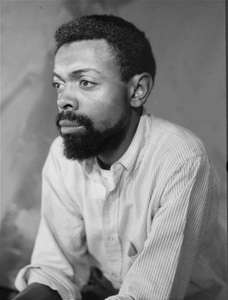
Write a short 400 or so word comment on the play Dutchman, paying particular attention to the long monologue at the end (starting on page 8) and how it relates to Baraka’s notions of music and culture in the selections from Blues People. Much of Larry Neal’s essay on the Black Arts Movement also deals with Amiri Baraka (then LeRoi Jones)’s work. What kind of distinction is Neal drawing between “protest poetry” and what he and Baraka are after? How does Dutchman relate to these notions?
Please remember to quote from the text! There’s also a selection of Baraka’s poems in the drive that I’d like you to read.

 New York Underground in Film, Music and Literature 1955-85
A coup de théâtre happens near the end of “Dutchman,” which is triggered not by an Aristotelian anagnorisis, but a shift of power relation between Clay and Lula. Here, Lula continues to dominate the dialogue as she does from the very beginning of the play, yet after she has mocked Clay of being “a middle-class black bastard” who is “just a dirty white man” (Baraka 8), or, to put it more clearly, a dirty white man-to-be, she finds herself subjugated both physically and linguistically to Clay’s revenge. This reversal of power relation echoes with Larry Neal’s opinion: the young African American’s violence symbolizes reflecting the latter’s idea that “the Black Power” means not a contention of social and cultural equality, but instead a violent “destruction of the whites thing, the destruction of white ideas, and white ways of looking at the world” (29, 30).
Both Neal and Baraka offer reason supporting this idea of violence, which should not be confounded with a simple, politicalized or expedient slogan for activism. Observing the black arts movement, Neal points out that in the past few decades, the real challenge of American black artists is the fact hat “it is impossible to construct anything meaningful within [the white system’s] decaying structure” (29), so their real cause turns out to be a search for new language, expression and philosophy which can perhaps correct the current crisis of the white western society. This point can be seen clearly in Clay’s outburst. He warns the whites, especially the male figures within the society to let the black people alone (9). Only with this distance between white and black, together with a whites’ presumption that their civilization is unable to totally understand the other group (or the other groups), can the white society finally ameliorates itself from the chaos at present, though it also means that the status quo should be inevitably “murdered” by this symbolic revolution (10).
The issue of intangibility then comes to the heart of this discussion, which urges us to go into as Baraka has justly done with his study of American black music, the historical and cultural context, beyond Neal’s synoptic description of black art development till the 60s in general. In “The Transitional Period,” Baraka concludes that blues and jazz differ from each other, majorly because the former bears an absolute autonomy which keeps it essentially obscure and incomprehensible to white people, while jazz is a black music form which in the beginning starts to reflect “Negro’s [sic] experience in America” (38), and eventually attracts white Americans to the emotional and intellectual fulfillment. However, it is not easy for jazz to become a real “common cultural ground where black and white America” meet (38), as Baraka has already demonstrates with his critique on the “swing jazz” (47), troubled by the fundamental problems such as capitalist hegemony, realistic social inequality, and historical prejudice for which black singers and their people exactly fight. Clay directly articulates the great names of black music such as Bessie Smith and Charlie Parker, and he also denounces all other forms of so-called blues music except for “the oldest one,” and so further emphasizes the fundamental intangibility of black culture that white people constantly fail to respect. The aggressive and oppressive manipulation of Lula, who seems to be only capable of beginning her sentence with “you will” when she addresses Clay (6,7), is only a microcosm of the reality of the dominator and dominated in the western society. “Western rationalism, or the great intellectual legacy of the white man” never allows them to listen (Dutchman 9), argue Clay and Baraka, just as with their definition of “serious” western music (“transition” 28), white people can only deem blues as a “non-diatonic,” “aberrant,” and “unsophisticated music form (27,28).
Yet it is also remarkable that in his monologue, Clay refuses to be “sane” (9), which suggests that he refuses to go through a simple power struggle, a sheer violence, in order to reverse the power relation that is insupportable for non-white people in the current situation. He argues that it is this tension between on the verge of sanity and madness, this rebel against oppression and the simultaneous renouncement of murder in return, that yields Smith’s as well as his own artistic creation. However, what is appealing to me is the dramatic irony which exists here. We cannot ignore that with his two slaps across Lula’s mouth, Clay has indeed become the executor of violence himself despite his self-claimed rejection. To struggle a culture into a general acknowledgement of the society involves seemingly inevitably a renewal of the power structure. On the other hand, the young artist advocates nothing but the oldest form of blues as an art of hope, yet according to Baraka, we can see that these melodies are purely Africa. That is to say, ignoring, or relegating his own experience of pain in the new continent, Clay may find great difficulty in arriving at the common plane ideally shared by white and black, instead of a new dominative structure or a disturbing chaos.
LikeLike
Amiri Baraka’s play “The Dutchman” relates to notions of music and culture in selections from Blues People. Both literary works inspect the idea of black culture guiding the creation of folk music, but the characters in “The Dutchman” twist this idea and grossly oversimplify it. When Clay states that “Plantations were big open whitewashed places…everybody on ‘em was grooved to be there. Just strummin’ and hummin’ all day,” Lulu enters hysterics and repeats “that’s how the blues were born” in an almost mocking way. The inception of blues is corroborated in “Blues People,” which states “blues could not exist if the African captives had not become American captives.” Originating from work songs, the references to blues music in “The Dutchman” is perhaps a way to communicate a continued harness on blacks. The dichotomy of the respectful description of blues music in “Blues People” and the derogatory terms used in “The Dutchman” reflects stigma toward the black community at the time, as throughout the events of the play Clay is continuously needled into a sharp response, which results in his death: in my eyes, the ultimate disrespect to blacks integrating into white society. It reflects a double standard to both remain true to one’s background so as to avoid becoming an “Uncle Tom” as Lulu puts it, and to integrate properly into a predominantly white society. “I sit here in this buttoned-up suit to keep myself from cutting your throats,” is a quote that exemplifies the way black community is forced to conform to American standards.
Larry Neal’s essay on the Black Arts Movement also deals with Amiri Baraka’s work, and Neal draws a distinction between “protest poetry” and white literature. “Black arts eschew ‘protest’ literature,” says Neal. The arts instead speak directly to black people, and the aesthetic that results is one formed by frustrations of black place in society. Neal writes, “the decadence and inanity of the contemporary American theatre is an accurate reflection of the state of American society.” Because black arts seems to be an art form for the black community during a different era than today’s, I am not confident that I can connect correctly with its content, but it seems to me that the black arts formed as was a counterpoint to mainstream ‘white literature.’ Neal argues that these arts must create its own ‘black aesthetic’ created by and for Black Americans.
In “The Dutchman,” Clay represents that black music and African-American culture and says that if Black Americans preached the same “rationalism and cold logic” as whites, they would rise up and murder Western men to end racism. This essentially states that black culture draws on yearnings and wishes, whereas white culture encourages violence and reductive thought.
LikeLike
“The white man learned that drums could be used to incite revolt as well as to accompany dancers … So the work song, as it began to take shape in America, first had to be stripped of any purely African ritual and some cultural reference found for it in the New World.” This quote in Baraka’s “Blues People” stood out to me in the context of “The Dutchman” and especially the ending monologue of the play, specifically what incites Clay’s anger and finally causes him to reach a breaking point and speak out. Lula is in a position of ignorant power throughout the entirety of the play, and she abuses it for her own amusement by making belittling assumptions, talking down to Clay, and toying with him both in her words and her touches, and Clay seems for the most part to allow it, but it is Lula’s mockery of the blues and the origins of it that becomes a catalyst for chaos and Clay’s breaking point: “And that’s how the blues was born.” Lula strips the blues of its culture, overstepping boundaries and claiming it for herself, turning it into a mockery of itself: “[Lula] begins to make up a song that becomes quickly hysterical. As she sings she rises from her seat, still throwing things out of her bag into the aisle, bumping into many of the standing people and tripping over the feat of those sitting.” The description makes Lula sound clumsy and clownish, putting on a mocking performance that’s appropriating and stereotyping the music of African American culture. Put into the context of Baraka’s writing on work music and the evolution of Black music into the blues emphasizes even further the complex and deeply personal history of the blues as a genre of music that grew from a history of oppression and suppression into something wholly culturally unique, and it adds more weight to the fact that it is Lula’s destruction of it that shifts the tone of the narrative and forces Clay out of his silence. “The idea of a white blues singer seems an even more violent contradiction of terms than the idea of a middle-class blues singer. The materials of blues were not available to the white American, even though some strange circumstance might prompt him to look for them.”
A significant portion of Clay’s monologue and the play in general appears to deal with Lula’s invasion of Clay’s space, literally at times, and then her subsequent attempt to remove him from his identity as a black man, even outright calling him “a dirty white man” at times, while also remaining aware at all times of her power over him and her prejudices against him as a black man. It’s a complex abuse of an unfair power dynamic and it connects strongly into Neal’s writing on the Black Arts Movement as an art movement uniquely by and for Black people, rather than for the consumption of white people. The Black Arts Movement is a reclaiming of and creation of an identity outside of the white expectation or suppression, and Lula’s mockery of the blues and all it stands for in Baraka’s eyes functions as a metaphor for a white society’s attempt at destroying and undermining that identity, while Clay’s response is one of not only reclaiming his identity and freedom, even demanding it from her with a cry of “Let me be,” but specifically outlining the threats of conforming to white expectations and white society. He makes it clear that her perception of black culture is one from an outsider, not something she will ever be apart of or understand from the position of power that she sits at – Proven by the fact that her “retaliation” is one of a violence without consequence.
LikeLike
Barka’s play The Dutchman reveals art as not only a communal form of revolution yet an individual medium as well through plays. By firing at Lula with his words within his monologue Clay forms an individual art piece. Clay’s continuous arguing with Lula throughout the play assists him in creating his own voice, he does so in subtle manners as she explicitly recites racist commentary. While Lula’s voice becomes her own form of expressing her racial comments, Clay simultaneously integrates his individual voice as an art piece. Where Clay and Lula differ aside from their races, becomes their ability in creating an instant change that aligns with their beliefs. While Clay fires back at Lula in his monologue he does so alone, however, he simultaneously represents an entire race and holds the heavy weight of fighting for others. Unlike Lula who argues for her own selfish desire of holding agency over a black male body.
In both characters, Bakar suggests that poetry becomes a means of art similar to music such as jazz. As the structures of both Lula and Clay’s speech differ within their arguments, Bakar demonstrates that different sounds within both tones of the characters’ speech throughout the play form art. As Clay voices in aggravation: “Now you shut the hell up. Just shut up,” he shifts his original art of solidarity and light strokes into a piece of splatter art. The solidarity initially visible as he intended in remaining friendly with Lula erases as she voices her aggressive racial commentary. As he dives into each conversation with her beginning with subtle strokes in order to understand her better, this faint tone of communication eventually fades. Lula’s comments create a necessary shift in Clay, as a voice for the Black community. By Clay instantly altering his tone towards Lula his splatter art becomes individual dots of anger towards each remark she has made, forming the art which becomes his lengthy monologue. Each remark Clay makes towards Lula such as:” You don’t understand anything but luxury”, suggests that while Clay creates this art piece alone he does so with the full understanding of the necessity in dismantling the privilege she believes she holds. In doing so Clay represents a majority while remaining as a minority within the situation.
Clay’s ultimate death by Lula reveals the difficulty in advocating for a revolution as an individual. However as Bakar uses the play as a medium of art which remains visible for all audiences, he does so with the intention of creating Clay’s individuality into a communal experience. Consequently, allowing future generations to read this play as art and view the individual revolution as necessary and useful.
LikeLike
You have to be much more careful in your blog comments. Here, you misspell the author’s name over and over again (and use different spellings) and in the post about “Howl” you don’t get the author’s name correct at all. The grammar is all over the place.
LikeLike
1. The Dutchman, by Amiri Baraka, is an exploration of the African-American plight during the late 20th century, and is symbolic of the generational fear amongst blacks. It is largely an artistic medium used by the author to exaggerate the evident lack of equality and contribute to the effect of shock. As Larry Neal states in “The Black Arts Movement,” “The motive behind the Black aesthetic is the destruction of the white thing, the destruction of white ideas, and white ways of looking at the world. The new aesthetic is mostly predicated on an Ethics which asks the question: whose vision of the world is finally more meaningful, ours or the white oppressors’?” (4). In the same manner, the play uses two main characters, Lula and Clay, to present the fundamental conflict of deep rooted prejudice. From the beginning Lula, a white-female character, manipulates Clay, an African-American male, ultimately resulting in his death at her hands. The racial difference between the characters is representative of the divide between the white and black community, caused by lack of social progression. The overarching question of racial superiority is relevant at this point in the text, and brings to light cultural differences. His stream of consciousness towards the end is indicative of the purpose of the entire Black Arts Movement, as it reveals that restrictions applied to African-American culture and expression. In reference to the mentioned monologue, there is a clear sentiment expressed by the following command: “Let me be who I feel like being. Uncle Tom. Thomas. Whoever. It’s none of your business. You don’t know anything except what’s there for you to see. An act. Lies. Device. Not the pure heart, the pumping black heart. You don’t ever know that. And I sit here in this buttoned‐up suit to keep myself from cutting all your throats. I mean wantonly” (9). Here Clay speaks on behalf of the black and artistic communities by publicly begging Lula to let him be himself. This request in the scheme of the text is seen as the opposition of the Black community against racist America, though his murder is indicative of the demise of equality.
2. A major part of comprehending the Black Arts Movement is knowing the intended audiences of each artist. These poets and musicians wrote mainly for the enjoyment of the black community. Rather than being subversive or attempting to derail the efforts of racist America, Black Arts authors wrote for the betterment/entertainment of their own communities. Larry Neal states, “The Black Arts Movement eschews ‘protest’ literature. It speaks directly to Black people. Implicit in the concept of ‘protest’ literature, as Brother Knight has made clear, is an appeal to white morality” (4). Artists of the time argued that appealing to a white audience is against the best interest of the Black Community, as it took away from the successes of African-American artists. They focused mainly on creating a “Black aesthetic” that would define a generation of lost Americans. Both Neal and Baraka used their works to the same effect. They composed music and literature for the black community and were able to discover an identity through common interests. Each work perpetuated the desire for a new cultural identity, and, with the contribution of countless black authors, was able to define an age of authors aspiring to further their culture. Baraka, ultimately, uses the play as a means of empowering the African-American community and overcoming the oppression of white America.
LikeLike
LeRoi Jones uses The Dutchman to critique how the Black man is abused for attempting to assimilate into White America. In the play, Clay a black man and Lula a white woman are on a train. Throughout the play Lula attacks him with racists remarks about his race and accuses of him of pretending to be someone he is not. Lula insults Clay, “You would-be Christian… you’re just a dirty white man” (8). Lula’s insults imply that Clay is trying to be white, through this accusation Jones uses Lula to highlight the importance of black people having their own art medium. Lula consistent teasing leads to Clay hitting her and becoming upset. This further represents how Clay attempts to modify who he is in order to be accepted by his peers. Jones uses Clay as an example that despite how hard the black man tries to fit in or assimilate, he will not succeed. Near the end of the scene Clay is fed up, he replies to Lula, “If I’m a middle-class fake white man… let me be…That’s not my kind of belly rub” (9). These two lines contradict themselves. The first part Clay expresses his decision to assimilate and that Lula should mind her business. Then he continues on his rant and he says the second part in response to Lula. Instead of continuing to play the part of the white man, Clay admits that they are not the same and his version of things differs from hers. Even when attempting to fit into white America Jones creates a character who finds himself rejecting Lula and her white America ways to be his own person in a black America.
Clay continues on his rant and he mentions famous entertainers like, Bessie Smith. He defends her, “They say, ‘I love Bessie Smith and don’t even understand…” (9). Clay highlights how white America only loves the surface of things. They do not care for the person but only their talents. This is further proved in Blues People Bakara makes the point, “Swing music, which was the result of arranged big-band jazz, as it developed to a music had nothing to with blues, had very little to with black American though that is certainly where it came from” (16).
Bakara explains that despite originating from Black America swing, blues, jazz would become white-washed. Even though they were all entertainers there was still a sense of us versus them and their white counterparts did not try helping the black musicians. Once they white musicians were able to mimic their tunes the black musicians were no longer needed. They would not receive the proper recognition or representation in the music community.
In The Dutchman the reader sees the importance of the black community needing its own identity within the arts. However, this idea proves difficult when Clay is surrounded by white America seeing as he only has a clear view of Lula and no other characters come into play or to his rescue when he is murdered. If Clay had had proper knowledge of the Black Arts Movement perhaps he would not have attempted to assimilate. In Larry Neal’s, The Black Arts Movement explains the importance of the black community having their own arts and their own representation. Neal says, “ The motive behind the Black aesthetic is the destruction of the white thing, the destruction of white ideas, and white ways of looking at the world” (4). This relates to The Dutchman, because instead of denying white America Clay attempts to conform to it, ultimately leading to his death. Through The Dutchman, and Blues People, there is the obvious theme of denying the white America in order to successfully prosper and live. The Black Arts Movement also argues that once the black man denies all things white america he will be able to understand the black aesthetic.
LikeLike
Throughout the Dutchmen there is an emphasis placed upon song and dance. In a way of allusion to LeRoi Jones’s writing on African American blues music. He points out the idea that music was a kind of bond for African Americans throughout history, and the music creates an eerie atmosphere throughout the play especially. After Clay is stabbed, and his body thrown off the train, another young negro is dancing and singing softly, as is the conductor. I think it’s his allusion to re-run history, and maybe the still somewhat obliviousness everyone has toward racism in america today. “An Afro-American work song could come about more quickly in slavery than any other type of song because even if the individual who sang it was no longer working for himself, most of the physical impetuses that suggested that particular type of singing were still present”, Baraka says in Blues People. This is echoed by the characters in Dutchmen, as Lula mocks Clay by dancing in front of him and singing songs that are meant to mock his culture. Clay, in his monologue, says, “Belly rub is not queens. Belly rub is dark places with big hats and overcoats held up with one arm. Belly rub hates you…”. Clay sort of blows up at Lula at the end and confronts her about her behavior. It is obvious that Lula is trying to coax Clay into a big reaction, and he gives it to her. The belly rub thing, I suppose, is about Lula not being able to understand the ideas placed behind these songs and dances that african americans had to cling to for many years without anything else. He also says, “Don’t make the mistake, through some irresponsible surge of christian charity to talking too much about the advantages of western rationalism…”. Clay refers to the charity that white people may be giving, purely out of guilt and not of healthy conscience. Even as Lula disparages Clay as an Uncle Tom or even calling him a white man, this seemingly is done by her to guilt him in his appearance and personality/identity as a black man.
LikeLike
Sorry, I did not mean to submit that comment yet. So, to pick up where I left off… Clay is a somewhat precarious, and mild mannered African American, pushed to the brink by Lula, as evident in the monologue. This severely challenges his personality, for he shoots from one place to another, and the decline to anger is steady, though his explosion is quick. And even as Lula disparages him, he stands for what he believes is right in the moment. So as she challenges the fundamentals of his culture/ cultural identity, he pushes back to her’s, which would be “white christian charity”. He berates her and accuses her and her culture of not understanding what it means, the dances and the music. That white culture celebrates now what they did nothing to create, as he says Bessie Smith would be saying, “Kiss my ass, And if you don’t know what, than it’s you that’s doing the kissing”. Again, he accuses Lula, but really the culture at large, of not understanding why and how this music is created. The white Americans celebrate Bessie Smith, but Clay seems to be alluding to the idea that Bessie had no other choice but the be exactly what he is. As Baraka wrote in Blue’s People, many African Americans got into jazz or blues as a means to make money, because it’s what they knew.
LikeLike
The ending of the “Dutchman” is shocking. Despite Lula’s bitterness toward African Americans, I did not expect Lula to murder Clay. The plot made more sense once I had read Larry Neal’s essay which describes the protagonists’ relationship as a representation of “the relationship between Black America and White America as rooted in the historical castration of black manhood”(34). Their relationship underscores the fact that in 1960 some whites wanted to continue their complete power over the black man and the ability to figuratively castrate him. For the most part, Lula dominates the conversation and Clay lets her be in control. Throughout the conversation she insults him “Did your people ever burn witches or start revolutions over the price of tea?” (Dutchman 5). Lula, like White America, in the 1960s clearly desired control. The insults she throws at Clay gives her dominance over him. Her insults are ropes pulling at Clay’s mind while he tries to remain calm and come up with a rebuttal. Lula explicitly says “I lie a lot. It helps me control the world” (Dutchman 2). After the stream of egregious insults and a mockery of the creation of jazz from Lula, Clay snaps. Clay had said that the “strummin’ and hummin’ on the plantations, were the way that blues were born” (Dutchman 8). According to Amiri Baraka, “blues could not have existed if the African captives had not become American captives”(21). Lula had quickly agreed, started humming a song and dancing hysterically. She mocks the creation of jazz, by trying to create a song and pretending that she understands the trails and tribulations that the captives went through to develop the sentiment within the lyrics and rhythm.
In Clay’s monologue, he explains that jazz might be a joke to her, only because she does not understand the meaning “Let them alone. Let them sing curses at you in code and see your filth as simple lack of style” (Dutchman 9). Baraka explains in Blues People that a few of the “unintelligible” songs are not as unintelligible as their would-be interpreters would have it”(25). Baraka supports Clay’s claim. In Blues People, he states that the work songs are what blues were born from and that these songs gave workers a way to communicate and sometimes act like morse code. Lula’s mockery of lack of understand of jazz is reminiscence of Westerner’s dismissal of the African non-diatonic music as stated in Baraka’s Blues People.
When Clay delivers his monologue, the roles are reversed and Clay is in complete control and dominates the conversation. Once he finishes his rant Lula stabs him because she cannot cope with the thought of losing authority to a black man. Killing him is the only way to end his power and rid herself of the idea that for a brief moment she was completely at the will of a black man.
Neal explains that protest poetry “affirms the integral relationship between Black Arts and Black people”(31). The poems put the art into words. The art embodies the African American cultural tradition and the “motive behind the Black aesthetic for the destruction of the white thing, the destruction of white ideas, and white ways of looking at the world” (30). The Black Arts movement was the visual analogue to the Black Power concept. The sentiment of the Black aesthetic can be seen in Clay’s monologue when he says “I sit here in this buttoned‐up suit to keep myself from cutting all your throats” (Dutchman 9).
LikeLike
Clay’s monologue at the end of Dutchman is the expression of what Neal describes as his “nascent knowledge of himself” (Neal 34). Until this moment, Clay has been playing along Lula’s inappropriate comments in hopes of it leading to sex. Eventually he erupts into truth about the middle-class black man that she mocks. In response to her mockery, Clay says “If I’m a middle-class fake white man … let me be. And let me be in the way I want.” (Baraka 9). Clay rejects her mockery of his language, name, and clothes. He claims his right to be whatever he wants to be. He is not responsible for being whatever Lula thinks he should be. Furthermore, he tackles western morals: “With no more blues, except the very old ones, and not a watermelon insight, the great missionary heart will have triumphed, and all of those ex‐coons will be stand‐up Western men, with eyes for clean hard useful lives, sober, pious and sane, and they’ll murder you.” (Baraka 10). The west’s limitless preaching of rationality erupts from “some irresponsible surge of Christian charity” (9). From the historical Christian notions of race, other races deemed inferior must be taught the universal tenets of rationalism and morality. All others must be molded into “stand-up” men that are busy in the Protestant work ethic. Clay remarks that all this preaching will lead to the demise of western society as it knows itself. Rationalism will become the tool by which the murder of white men will be justified in the same way that it was used to justify the atrocities of colonialism. The freedom and justice of the people that sing the blues, that people like Lula think they comprehend, can come from murder of white ideas. The insanity of murder is the simple sanity that explains the pain the blues were born from. Putting on a suit and playing the role of middle-class white American is a part of assimilation and survival in White America. Clay has a knowledge of himself and of white ideals. Interrogating them or opposing them in any way, claiming autonomy “threatens the existence of Lula’s idea of the world” (Neal 34). The existence of black awareness and knowledge of self is contradictory to the very ideals white America is created upon. Lula’s idea of the world requires a subjugated, obedient Clay that conforms to her vision of a black man, a man she thinks she can understand.
Larry Neal explains that “The Black Arts Movement eschews “protest” literature. It speaks directly to Black people” (30). The work that he and Baraka are doing is not attempting to explain the struggles of black people to white people or convince them to validate them. The purpose of black art is not to propose the humanity of a subjugated people; it is not explaining the wrongs that have been done. Black art is for black people. Clay’s monologue is an example of what black art is, the black vision if the world, not a proper “appeal to white morality.” It discards the white view of the world and freely expresses its own truth.
LikeLike
In The Dutchman, Clay’s character gives a fictional face and voice to Baraka’s view that although white people enjoy the blues and jazz, they can’t understand the essential message and origins of the music. Both jazz and the blues are descendents of West African work songs brought to the United States with the slave trade. These work songs morphed as the centuries progressed, and many of their signature aspects (such as improvisation and call-and-response vocals) can be seen in modern blues and jazz music. In Clay’s final monologue, he expresses his frustration that white listeners don’t recognize the music’s true message, saying “they say ‘I love Bessie Smith’ and don’t understand that Bessie Smith is saying ‘kiss my ass, kiss my black, unruly ass.’” As a fictional character, Clay can passionately, even aggressively, express his frustration. As an academic, Baraka must be more restrained in expressing his sentiments. He writes, “the reaction of young white musicians to jazz was not always connected directly to any ‘understanding of the negro’” (39). Compared with Clay’s passionate reaction, Baraka’s poised observation seems like an understatement. Looking at The Dutchman and Blues People in conjunction, it is clear that they have the same message, but the former is an artistic, passionate outcry, while the latter is an academic, logical analysis.
In his essay, Larry Neal notes the major difference between “protest” literature and a completely revolutionary and new set of ideas. Neal dislikes what he calls “protest literature” because “implicit in the concept of ‘protest’ literature… is an appeal to white morality…” (30). In his eyes, to protest would be to ask his oppressors for mercy. Instead, he suggests that black people should seek “the destruction of white ideas, and white ways of looking at the world” (30). He believes that black people should not seek to fit their desires into a preexisting white system, but should instead seek to destroy that system and build a new one. In The Dutchman, Baraka uses Clay’s desire to murder white people as a metaphor for the author’s own desire to obliterate white ways of thinking. In Clay’s final monologue, he declares to Lula (and to the white community at large), “when you really believe you can accept [black people] into your fold… all these ex-coons will be stand-up Western men… and they’ll murder you, and have very rational explanations. Much like your own.” The “rational” explanations that Clay refers to are parallel to the rational explanations Baraka gives for the need to create a new way of thinking.
LikeLike
The interaction between Clay and Lula escalates rapidly through “The Dutchman” and ends with the murder of Clay after he roots himself more deeply into his truth. Throughout the play, Lula’s racism is revealed and is only heighted within each scene, causing Clay’s anger and frustration to grow around the damaging stereotypes Lula has placed upon him. Lula has managed to control their conversation from the top of the play, yet it is in the end where the dominance shifts to Clay, at least for a moment. Clay uses his power to deliver a monologue in which he begins by calling out Lula’s racism. Baraka then leads Clay’s train of thought to addressing the role of music and art within black culture, and how it is grossly misunderstood among white audiences. Clay explains the reason artists like Charlie Parker and Bessie Smith are creating is to stop themselves from “being sane” (9). He says that his people are “a whole people of neurotics” and “the only thing that would cure the neurosis would be your murder”, referring to Lula and white people as a whole. It is through the music that the musicians are attempting to work through these complex feelings. In Blues People, Baraka spends time explaining the history of black music beginning with how the music of African slaves was transformed in the first generation of African-American slaves and beyond. It was out of slavery that blues was born, and from the blues emerged jazz. Clay is explaining that this music and in his case, his own poetry is what has kept him from murdering. His art takes the place of this desire to kill, and this is understood when he says to Lula, “Just let me bleed you, you loud whore, and one poem vanished.”
In Neal’s essay, he draws a distinction between The Black Arts Movement and “protest” literature saying that, it is the Black Arts Movement which “speaks directly to Black people” whereas “protest” literature “is an appeal to white morality” (Neal 30). What Neal and Baraka are after is creating art for the African-American audience that “must see itself and the world in terms of its own interests” (39). Neal draws attention to the fact that theater is often rooted in escapism in which white audiences are “refusing to confront concrete reality”(33). Baraka fights against this idea in “The Dutchman” as he makes his audience connect to, and face the realities of their world. Both men are aware of the power theater can invoke, as it is “the most social of all the arts” and in Baraka’s play, he does this through the tragedy in the finale (33). Clay’s existence poses a threat to Lula and his murder is a reminder of “the historical castration of black manhood…” (34). In the final actions, Lula’s dominance is asserted yet again as she gets away with murder, and is still regarded with respect by the Conductor who tips his hat to her in the end.
LikeLike
Clay’s dynamic in the penultimate scene becomes an argument to re-contextualize Black art and culture away from white appropriation. indignation at Lula’s imitation of a belly rub is resisted by the exclamation “that’s not my kind of belly rub. Belly rub is not Queens” (8). The Belly Rub in The Dutchman mirrors how Baraka describes the cultural origins of the Charleston in Blues People, explaining that its “a West African (Ashanti) ancestor dance” (29). Both of these comments get at the robbery of Black cultural identity through movement, which has an interesting modern comparison with Fortnite Dance Ownership controversy, and while the contemporary controversy stems from the legality of replicating the dances in the game, many have spoken up about the aesthetic and racial issues this appropriation carries with it (https://www.theverge.com/2018/12/20/18149869/fortnite-dance-emote-lawsuit-milly-rock-floss-carlton). Indeed, Baraka is concerned with the same cultural baggage of reclaiming pieces of Black art and not letting the Black image be taken over, in his case by a white woman, but in the real world by corporations. That struggle helps explain why Lula ascribes the title of ‘Uncle Tom’ to Clay in the Dutchman, which itself is a racist caricature of a Black man invented by a White woman. In his article The Black Arts Movement Neal argues that “the Black artist must create new forms and new values, sing new songs (or purify old ones)” in order to resist racist caricature and the appropriation and exploitation of Black art (30). This explains why Baraka has Clay confront the white woman; for him it is a matter of life and death, or more appropriately a question of survival. The fact that Lula has the political and social ability to murder Clay in broad daylight is a direct consequence of the mythologization and structure of her fictional superiority. Even her whole tone throughout is patronizing, suggestive and chiding. Clay exclaims “I sit here in this buttoned-up suit to keep myself from cutting all your throats” (8). In other words, his tolerance of their ignorance is what gives them the means to ignore him. It’s a catch-22 without any way for Clay to claim his body. Lula seeks to make him perform for him, and when he will not, when he has a mind of his own and speaks it, she kills him.
LikeLike
In Amiri Baraka’s “Dutchman,” a few lines prior to Clay’s furious monologue, Lula calls him “just a dirty white man.” This struck me as similar to how white critiques of blues were, per Baraka, “attempts to explain one musical system in terms of another; to describe a non-diatonic music in diatonic terms.” Both Lula and these critiques of blues use whiteness and white culture as a default standard or frame of reference in their dismissal of the Black entity they judge. Part of Clay’s outburst that follows – specifically his point that if African Americans operated on principles of white, western rationalism, they would “murder you, and have very rational explanations” (Dutchman 10) – brings out the fallacy inherent in this mode of judgment. Black art cannot exist in the face of western rationalism, as it is an outlet for emotions that, according to Clay, a rational thinker would resolve in another, more violent way. Thus, the very thought processes that go into creating Black art and western art are extremely different. As Baraka writes, “While the whole European tradition strives for regularity – of pitch, of time, of timbre and of vibrato – the African tradition strives precisely for the negation of these elements” (Baraka Reader 31).
Also, this mode of judgment stems from the white person’s (the oppressor’s) belief that Black art is created for their consumption, and therefore that their metrics apply to it. This is also Larry Neal’s conception of “protest” art, which he sets up in opposition to the Black art he advocates for, and in his opinion, Baraka creates – art that “speaks directly to Black people” (Neal 30). Frantz Fanon, whom Neal references, expresses similar ideas in “The Wretched of the Earth.” He believes a violent break from the oppressor’s culture, one that allows for a national consciousness separate from it, is necessary in the creation of a new culture, which creates and addresses a “completely new public.” He sees art that addresses one’s own people as a sign of the people’s progression away from oppression.
Clay’s ideas of art don’t seem to have progressed that far, however. His understanding of Black art seems closer to “protest” art – he says “Bessie Smith is saying, ‘Kiss my ass, kiss my black unruly ass’” (Dutchman 9), implying she addresses a public that is not Black. In a way, it seems Neal’s ideas haven’t gotten there either – he writes that Black art must address Black people, but also frames it as “a radical reordering of the western cultural aesthetic” (Neal 29) – a description that perhaps does exactly what Baraka says white critiques of blues do, showing an inability to escape the normalized perspective that western art is the default frame of reference.
LikeLike
In the play, “The Dutchman,” Baraka uses Clay as an example of what happens to Black men when they attempt to integrate themselves into White society, and in the same way, uses Lula to represent White society’s response to this attempt at assimilation. When Lula states, “And why’re you wearing a jacket and tie like that? Did your people ever burn witches or start revolutions over the price of tea? Boy, those narrow‐shoulder clothes come from a tradition you ought to feel oppressed by. A three‐button suit. What right do you have to be wearing a three‐button suit and striped tie? Your grandfather was a slave, he didn’t go to Harvard,” it becomes evident that she does not agree with Clay’s attempt to assimilate himself into her society, rather she believes he should still feel oppressed and takes on a tone that mocks the way in which he is trying to present himself as something he is not — essentially turning him into a “fake White man.” It is only when Lula begins to sing and dance that Clay becomes fed up with her actions, subsequently slapping her as he yells at her in rage. Lula’s song continuously states, “And that’s how the blues was born. Ten little niggers sitting on a limb, but none of them ever looked like him,” which follows the foundation for belief in “Blue’s People,” that, “blues could not exist if the African captives had not become American captives” (21). Blues was born out of African American work songs that were sung in American fields; however, these same works songs had lost their original relevance from the West Africans when, “They became the realized circumstances of a man’s life after he had been exposed sufficiently to their source and catalyst — his enslavement” (23). In this way, the original native songs were transformed into something more contemporary and acceptable, resulting in their translation, and therefore, meaninglessness. When Clay states, “You don’t know anything except what’s there for you to see. An act. Lies. Device. Not the pure heart, the pumping black heart. You don’t ever know that,” he is stating that whilst he may be a fake white man, Lula is the ignorant one because she does not truly understand Black culture or the true meaning of the blues. Through this monologue and Clay, Baraka is saying that white people should not interfere with their black expressions or arts because, “That’s not my kind of belly rub. Belly rub is not Queens. Belly rub is dark places with big hats and overcoats held up with one arm. Belly rub hates you… Old bald‐headed four‐eyed ofays popping their fingers … and don’t know yet what they’re doing.”
In terms of Neal’s essay on the Black Arts Movement, “The Dutchman,” represents the way in which plays are an important artistic tool in the Black Arts Movement as it is used as a way to bring attention to the struggles that come with a Black man’s attempt to successfully assimilate himself into a society governed by White people. After all, “These plays are directed at problems within Black America,” (39). This play, like many others highlighted in Neal’s essay, is a movement meant to evaluate a Black male’s presence in America — in this case, Clay — must continuously struggle for their survival.
LikeLike
In Amiri Baraka’s Dutchman, the ideas of oppression and enslavement of the African American population are discussed, with an emphasis on art and music serving as cathartic measures for the enraged Black people. “Charlie Parker? Charlie Parker. All the hip white boys scream for Bird. And Bird saying, “Up your ass, feeble-minded ofay! Up your ass.”… Bird would’ve played not a more of music if he just walked up to East Sixty-seventh Street and killed the first ten white people he saw. Not a note!” This quote from the play signifies the suppressed rage that the black people felt, which they released through their music and art. Baraka also references Bessie Smith, a singer, and says “They say “I love Bessie Smith and don’t even understand that Bessie Smith is saying “Kiss my ass, kiss my black unruly ass.” This underlines how black artists arise solely to emote their anger against their white oppressors and use their art to form a community amongst themselves and a movement to stand up against their unruly enslavement. Clay’s soliloquy at the end of the play indicates that Bird’s or Bessie Smith’s music is cathartic, which prevents them from acting on their anger and killing the oppressors. When compared to Blues People, Baraka maintains this attitude of catharsis by identifying the roots of both Blues music and also the “work songs” that the slaves sang. He wrote, “They [work songs] became the realized circumstances of a man’s life after he had been exposed sufficiently to their source and catalyst – his enslavement.” This, to me, speaks to the core purpose of art and music for the African American population and also the core purpose of the Black Arts Movement. Along with emoting their struggles and anger towards their oppressors, but it was also a medium of revolutionizing their political and social status in a White America. With no freedom being given, Blues People was Baraka’s way of educating his white audience that music such as jazz originates from the exploitation of the black people, “It [Blues] is a Native American music, the product of the black man in this country.” By calling Blues a “product of the black man,” Baraka is identifying that music and art go beyond just forms of entertainment. They are also a commentary on the social hierarchy and the injustice that was present in the White America of the time.
Additionally, Larry Neal’s “The Black Arts Movement” comments on black people being proud of their culture and protesting against the white population, “any Black man…who adheres to the white aesthetic, and who directs his work toward a white audience is, in one sense, protesting. And implicit in the act of protest is the belief that a change will be forthcoming once the masters are aware of the protestor’s “grievance.” In aiming to write or sing specifically to a Black audience, Neal urges the Black artists to create a community amongst themselves, which is what’s removed by their white counterparts. He argues that the social struggles of the black people and political injustice towards them should go hand in hand with the aesthetic of an art. He defines protest as a way to reach out to a white audience with the political goals in mind for the betterment of the black community. Overall, all these works aim to emphasize the significance of art to be beyond just entertainment and to emphasize that not all art is equal, with their origin underlying he struggles of an entire population.
LikeLike
LeRoi Jones’s play The Dutchman ends with the dramatic and unexpected murder of Clay by the hands of Lula. What builds on this surprising twist even more is how the play began with our introduction of Clay as an African-American individual of a relatively intellectual stature. Lula however is immediately recognized as the antagonist who begins to have a back-and-forth bantering dialogue with the young black man eventually attacking his race, a topic which Clay visibly seems troubled by. This is where Jones’s play relate most with Amiri Baraka’s notions of music and culture in the selections from Blues People. Lula’s questioning of Clay’s “three-button suit and striped tie dress code” , as well as her indication of his grandfather’s status as a “slave” who “didn’t go to Harvard”, are all statements that spark a string of prejudice remarks towards the African American race. Eventually the interaction grows to Lula essentially taunting Clay. Clay’s response is in my opinion ironic in a sense and almost a symbol of dark humor. Lula is baiting Clay into acting like the rebellious and revolting black man she is stereotyping him out to be–a concept also cited by both Larry Neal and Amiri Baraka. Clay unfortunately takes the bait and acts violently towards Lula. However, to me, I see the main character as acting out in more of a panic mode sense than actual malice. Indeed, this makes sense as Larry Neal pointed out in his article showcasing the Black Arts Movement, that this play is Jones’s “Black art” or “Black aesthetic” piece in which his two characters at odds are “Black America (Clay)” and “White America (Lula)” The fact that the play perfectly shows the violence by both parties is significant in that it is the best example of the distinction between Neal and Baraka’s agenda and typical “protest poetry” or “protest literature” in that the latter has an implicit appeal towards White Americans while the first is aimed “directly” to Black individuals. Jones’s poem once again is essentially an early work of playwright protest that embodies the very agenda of Neal and Baraka in that African American individuals who face the same struggles as Clay on a daily basis are the direct target audience.
LikeLike
At the end of the Dutchman, Clay explains the white mans burden from a black mans perspective, by stating African Americans are dehumanized by white-defined stigmas and caricature. Clay asks for Lulu to “let them sing curse at you in code and see your filth as simple lack of style,” as warning of rebellion, since this secret way of communication is all the African American culture has. Throughout the play, Lula’s actions showed the cyclical nature of suppression, and gives context to how the blues was birthed in response to their conditions; this is essential in communicating the collective strife needed for a culture to preserver. Both Baraka and Neal are after establishing that the roots of the African American culture are within the secrecy of rhythm and the blues, which is a systemic byproduct of oppression and suppression. Barack deals with showing a history that reflects the foundation of the tone of blues. He states the African language uses “rhythmic qualities” to communicate because their usage of drums influenced their language (Barack 28). The comedic timing was essential to the character development, and Barack uses black humor so that the audience is able to accept the tension between dialogue and space, which is used at the end to trigger, and inevitably killing, Clay. Neal states that “the Black artist must address himself to this reality in the strongest terms possible,” because he has to fight beyond the confines his identity is put into (30); I believe that Clay was too honest and strong, and that lead to his death, since he incited a rebellion. These direct claims show a type of art done by Black artists in protest against the white mans need to dehumanize another race out of an insecurity with power imbalances. In all, the fight by the suppress continues and the same tactics are played among the oppressor, therefore making this hate systemic, and the art a reflection of these situations.
LikeLike
Amiri Baraka’s Dutchman is a play that reflects on African-American racial identity through the encounter of a young Black man, Clay, and an older white woman, Lula. Clay’s monologue is a visceral, shocking, and vulgar defense of his identity against the colonial pressures of white America. This violent outburst against Lula culminates in his murder; a reflection of the treatment of minorities who stand against white America. This monologue largely relates to Baraka’s ideas of the evolution of African music and culture into African-American music and culture. In Blues People, Baraka argues that there was a generational “break” in this culture due to both the influence of “Euro-American culture” and the absence of “Africanisms”: “So the music which formed the link between pure African music and the music which developed after the African slave in the United States had had a chance to become exposed to some degree of Euro-American culture was that which contained the greatest number of Africanisms and yet was foreign to Africa” (Baraka, 22). In this way, “African” cultural products that had been forcibly taken to America were necessarily changed. This was due largely in part to the way that slaves were not allowed to practice many of their cultural traditions. In other words, “African speech, African customs, and African music [were] all changed by the American experience into a native American form” (Baraka, 26). This oppression is revealed in Clay’s outburst in Dutchman by his refusal to perform the identity that Lula expected of him. Throughout the play, Lula correctly stereotypes Clay based on his “type”, and playfully demeans him for it. In his outburst, Clay doesn’t try to rebel against this identity, as is expected: “If I’m a middle-class fake white man … let me be. And let me be in the way I want” (Baraka, 8). Baraka is suggesting through this comment that Black people should have a self-determining power of identification. Because their past was taken from them and their culture forcefully changed, white America often expects Blacks to want to define their current culture against this past oppression. However, Baraka indicates that Blacks should be able to determine their own culture.
In response to Baraka’s notions of cultural self-determination, Larry Neal explicates on a “Black Arts Movement” that is not a reaction to white culture, but is an alternative culture that seeks to supplant white culture. In “The Black Arts Movement”, Neal argues that such a movement “eschews ‘protest’ literature. It speaks directly to Black people” (Neal, 30). Neal does not seek a movement of protest poetry in which the hegemony of white America is sought to be changed. Rather, he seeks a black aesthetic that is “the destruction of the white thing, the destruction of white ideas, and white ways of looking at the world” (Neal, 3). Neal and Baraka seek to establish a new culture for Black people, one that is not dependent on colonial narratives or cultural determinism. In Dutchman, Clay represents a realization of this self-determining power. After he sees through Lula’s aggrandizing seduction, Clay boldly proclaims the true feeling of Black artists: “Bird would’ve played not a note of music if he just walked up to East Sixty‐seventh Street and killed the first ten white people he saw” (9). In other words, the culture that Black artists perform for white America would not be necessary if they were allowed to truly express their emotion and identity. A similar notion is given by Neal in “Black Arts Movement”: if one “cuts deeply enough into the most docile Negro, [they] will find a conscious murderer. Behind the lyrics of the blues and the shuffling porter loom visions of white throats being cut and cities burning” (36). Neal and Baraka argue that Black artists should no longer deny their true emotions, but should stand against their oppressors.
Amiri Baraka and Larry Neal argue for a Black arts movement that “[relates] broadly to the Afro-American’s desire for self-determination and nationhood” (Neal, 29). Instead of shaping a Black Arts movement within the context of white culture, they argue that there should be a new culture entirely. The “unrealistic” white theatre should be supplanted by the real, visceral experiences of the oppressed; the antithetical “protest poetry” should be replaced with self-determining poetry; and the ideology of the colonizers must be done away with entirely.
LikeLike
The monologue at the end of Dutchman reads like an outpouring of Jones’ beliefs about blackness, black art, and the struggle of trying to live in a white society. For most of the play, Clay wears a suit, is quiet and genteel, calls himself a black Baudelaire — in other words, he forms his public image in the mold of white society. But at the turning point of the monologue, this veneer is broken open like an eggshell, and Clay reveals himself to be much more than the “Uncle Thomas” Lula calls him. He tells her that “If I’m a middle-class fake white man… let me be… An act. Lies. Device” (9). In other words, he may have been living the way white people wanted him to, but beneath it, he recognizes himself as an outsider, as someone who is a member of the black nation-state Neal discusses. He is unwilling to hide it any longer.
This shift starkly portrays the differences between what Neal labels “protest poetry” and Black Arts. Protest poetry, he contends, works within the framework of existing white society. Black Arts, like Jones’ work, create an entirely new framework, one borne of black identity and culture, in political and aesthetic opposition to Western tradition. Neal writes that “implicit in the concept of ‘protest poetry’… is an appeal to white morality” (30). But Clay has had enough, and doesn’t care about what white people think anymore: he threatens Lula, and the other white people on the train, with murder, in visceral terms.
Clay is not violent in actuality, beyond slapping Lula. Rather, he uses violent rhetoric. In contrast, Lula murders him for speaking up for himself, for stepping out of bounds. Like Neal contends, “even though Western society has been traditionally violent in its relation with the Third World, it sanctimoniously deplores violence or self assertion on the part of the enslaved” (35). Jones makes that double standard clear: the passengers on the train, who he explicitly states are black and white (1), allow Lula to call him racial slurs, to denigrate him, et cetera. But the moment Clay slaps her, threatens to break her hold on him and take back his agency, he is punished for it. The passengers allow her to murder him, and are complicit when they help her cover it up. The social order is maintaining itself, by allowing violence on the part of the oppressor, but quashing it when it arises from the oppressed.
Jones also makes several references to black cultural icons in Clay’s monologue. He says of Bessie Smith that she’s “saying, ‘Kiss my black ass,'” to white Americans (9) and that Charlie Parker is likewise saying “Up your ass” to the same people (9). Then Jones draws a clear connection to the Black Arts movement; Clay explains that their pain led to their music, and that if they’d let off steam by killing white people, they wouldn’t have had made a sound. This connects clearly to the legacy of black music (and American music in general, which is derived from it) that Baraka lays out in Blues People. He stresses the legacy of black music in African traditions, but also grounds it in the realities of generations of people living as slaves, and the pain comes through in that music. He specifically mentions Charlie Parker, just as he did in Dutchman. Baraka writes that Parker’s music was misapprehended as “raucous and uncultivated” but that it was “meant to be both those adjectives” (31). Under Baraka’s reframing of musical legacy, black music is legitimized. White criticism is due to ignorance and close-mindedness, not superiority. So by mentioning Parker in Dutchman, it seems that Jones was legitimizing his art as something captivating. At the same time, the mentions of Bessie Smith and Charlie Parker are tied to Lula (and white society’s) utter misunderstanding of those musical forms, and their significance to the (separated, Othered) Afro-American community. If Lula doesn’t get that Bessie Smith was telling her to kiss her ass, Clay says, “it’s [her] doing the kissing” (9). Indeed, Lula seemed to fancy herself some sort of expert on blackness throughout the play, a smugness about who he was that extended to boxing him into her mental image of him, telling him what to do, exactly what he could and could not say, all while calling him a “n***er.” Clay finally puts her in her place in the final monologue. Symbolically, it’s as if the black community, through Jones/Baraka, is saying “I see what you’ve been doing and I won’t stand for it anymore.” But with the play’s tragic end, it seems Jones had little optimism for white society’s response. Indeed, if we look at other black men who tried to stand up for their community and used violent rhetoric — such as Malcolm X — we see that Jones may not be far off the mark at all.
LikeLike
In the words of Baraka, “Thought is largely conditioned by reference; it is the result of consideration or speculation against reference, which is largely arbitrary” (Baraka, 40). In Dutchman, Baraka rejects white reference, refusing to write a “good” play as labeled by white America, or a protest that is written for the white reader so “a change will be forthcoming once the masters are aware of the protestor’s ‘grievance’”(Neal, 30). Throughout the play, Lula stereotypes Clay by his color and his clothing, saying things like “I told you I didn’t know anything about you… you’re a well known type” (3) and “Your grandfather was a slave, he didn’t go to Harvard” (5), yet seduces him and lures him physically to satisfy some twisted fantasy she has. At the end of Dutchman, we see Clay turn verbally and physically on the racist Lula after allowing her to practically abuse him for the majority of the play. Finally pushed to his limit after her racist taunts and obscene behavior, he says exactly what he feels: “Just let me bleed you, you loud whore, and one poem vanished. A whole people neurotics, trying to keep from being sane. And the only thing that would cure the neurosis would be your murder. Simple as that.” (Jones, 7). If we take Lula as the representation of white America, no white reader’s morality will be touched by Baraka’s play; he is not attempting to write according to the white reference of thought that would appeal to white America. Rather, Baraka rejects this reference entirely, speaking instead directly to and for Black people. He doesn’t write for the white reader, but for the Black reader, who can relate to Clay. Not only is the frame of reference Jones uses to write the play entirely catered to Black people, but the unfolding of the play itself reflects this rejection of white standards and the creation of “a new history, new symbols, myths and legends (and [purification] of the old ones by fire)” (Neal, 30). Throughout the play, motivated both sexually and by “the native’s belief that he can acquire the oppressor’s power by acquiring his symbols, one of which is the white woman”(Neal, 34), Clay allows Lula to continue to abuse him and his truths. However, at the end, it is as if Clay realizes exactly what Neal is referring to by his quote on black traditions and the need to “purify the old ones:” he turns on Lula, seeing her murder as the only solution. The representation of black America turns on white America instead of attempting to assimilate to her values and satisfy her twisted fantasies, and sees her murder, or the purification of references to thought, as the only solution to the black Man’s circumstance.
LikeLike
Amiri Baraka’s play the Dutchman explores the significance and force that black self-determination and nationhood in art can have in terms of the black community’s relationship with the white western world. In the excerpt from Blues People, Baraka discusses the white’s perceived threat of black working songs simply based on their inability to understand the construction and meaning behind these songs. Baraka states that “references to religions of Africans were suppressed by the whites… because they naturally thought of any religious customs are barbarous” and this could also mean that “particular Africans were planning on leaving the plantation as soon as they could” (23). Much as how these white plantation owners stripped the workers of any culture within their songs, Lula in The Dutchman claims that Clay is just a “dirty white man” because he refuses to “rub bellies” with her on the train. This claim of Clay as being white and not of the black culture along with her oversimplification and lack of respect for the blues music symbolizes this same stripping of culture in music that Baraka mentions in Blues People.
In addition, these plantation owners attempted to suppress African culture because they viewed them as a threat. Not only a threat to their business but a threat to the endurance of the white western culture. In The Dutchman, Clay is ultimately killed after he finally speaks out for himself and his people. This stands as a symbol for the relationship of the white and black communities of the time. Lula continuously degrades Clay in a semi-humorous way that makes Clay, at first, feel loved and appreciated just enough to play along; and when he didn’t anymore, she got scared and killed him. Similarly, white people of the time and during slavery were okay with African American people just as long as they were westernized enough to disguise their culture. Baraka claims that plantation owners allowed for working songs as long as there was no “barbarous” African culture involved and Lula was okay with interacting with Clay when he was “a dirty white man,” ignoring of her shaming comments.
Larry Neal addresses this theme of the transition to the acceptance and realization of black culture in his essay. He claims that poetry is “a concrete function, an action” that can be used to communicate and create “a collective conscious and unconscious of Black America” which is the “will toward self-determination and nationhood” (32). In this way, he is saying that “protest poetry” is a means of stopping the subversion of black culture at the hands of whites. Similarly to how the blues allowed African Americans to embrace their culture and change the perception of African music from something thought of as “childish” and lacking grammatical and rhythmical expertise (25-26) to something valued and practiced in the white community, Baraka use this “protest poetry” to reinvent, or create a Black American culture that removes African American’s from being “only a set of reactions to white people” (33).
LikeLike
The topic of Black Power is evident in Amiri Baraka’s Dutchman when Lula urged Clay to partake with her in “rubbing bellies”; her misinterpretation of black art dance describing the problematic conundrum of “protest poetry” (or in this case, “protest art”) in that its dance form is to “adhere to the white aesthetic…And implicit in the act of protest is the belief that a change will be forthcoming once the masters are aware of the protestor’s ‘grievance’” (Neal 30). In Clay’s frustration, her insistence to partake with her and to ignore his American middle-class status in favor of being like his “old rag head mammy” insinuates disrespect, let alone a white interpretation, to culture born out of strife from the slavery era in Black culture. Furthermore, Clay’s ancestral heritage is appropriated with Lula’s interpretation of plantations having wires as per the concentration camps where Jews were held during WWII, creating a reinterpreted history of Black folk merely held by physical force rather than an institutionalized slavery and weakening the drive for Black Power. Such term, as defined by author Larry Neal, is described as “the necessity for Black people to define the world in their own terms”, as well as “the opinion of many Black writers [find] that the Western aesthetic has run its course…The cultural values inherent in western history must either be radicalized or destroyed…In fact, what is needed is a whole new system of ideas.” (Neal 29). Going back to Baraka’s screenplay, Clay’s anger is triggered by the rebranding of this Black Art and rages about the latent drive of Black artists hoping to rid themselves of white people, if not cathartically murder such. The drive of not only reclaiming back what was appropriated for white masses, as well as the eradication of a white system, aligns with Neal’s thesis of what Black Arts mean for the Black Power movement.
Comparing the dances of “doing the nasty/rubbing bellies” alongside the drive for Black Power, Neal and Baraka both urge the drive to create Black Art to distribute the message of Black Power to the masses (to address the spirit of Black, not White, America). Their ideology is consistent with the ideals of various Black philosophers to include Frantz Fanon (“Destroy your culture and you destroy your own people…Black artists are culture stabilizers; bringing back old values, and introducing new ones. Black Art will talk to the people and with the will of the people stop impending ‘protective custody.’”) and W.E.B. DuBois (“Thus all art is propaganda and ever must be, despite the wailing of the purists. I stand in utter shamelessness and say that whatever art I have for writing has been used always for propaganda for gaining the right of black folk to love and enjoy. I do not care a damn for any art that is not used for propaganda. But I do care when propaganda is confined to one side while the other is stripped and silent…”). For both, Black Art is functional only in its drive to defend and promote Black Art, and essentially Black Power. In keeping Black Art alive and abundant within the community, Black Power can be further propagated into action and lead in to eventual replacement of a White system with that of the Black spirit, hoping that the everyday black Clay will not fall victim to a corrupt white Lula system of death.
LikeLike
The largest tie that I found within the Dutchmen and the presentation of the Black Arts Movement is Neal’s mention of Brother Knight’s quote, “Only when that belief has faded and protesting end, will black art being”. He later states, “to accept the white aesthetic is to accept and validate a society that will not allow him to live”. The former quote can most obviously represent the symbolism within the Dutchmen, and I believe that Baraka used Clay’s character as a lesson to fellow African American’s. Clay’s physicality is not described within the beginning of the play in the way that Lula’s is. Instead, his appearance is unfolded through the eyes and interpretations of Lula within the fifth page of the manuscript. She states, “What’ve you got that jacket on in all this heat for? And why’re you wearing a jacket and tie like that? Did your people ever burn witches or start revolutions over the price of tea?…Your grandfather was a slave, he didn’t go to Harvard” (Jones/Baraka). Through quotation, Lula is automatically calling attention to Clay’s attempt to assimilate within the “white aesthetic”, and instead brings to light the heritage and past that is assumed of him. Even though his particular grandfather was not a slave, merely a nightwatchman, that history of enslavement should always be a part of him due to Baraka’s quote, “the black arts movement believes that your ethics and your aesthetics are one”. This can’t be the case with Clay because his ethics are black, but his aesthetic is white. Due to this problem, he has to be killed at the hands of the white woman. One would automatically assume that he would be evermore desirable to Lula due to his attempt at assimilation, however, Baraka wants to shy away from that reading in order to parlay that no matter how hard Clay tries to gain acceptance from Lula he will never succeed. Baraka is almost putting the white aesthetic by the black man in a more dangerous principle than the black man in a black arts aesthetic.
LikeLike
This play reminded me of a 1960s version of Jordan Peele’s “Get Out.” It’s kind of crazy to think that people have been discussing race relations in this way for so long. But, while the white villains at the end of Peele’s film eventually meet their violent ends and can no longer live to terrorize the Black people they trap into their lives, this play is just the reverse. The ending was very surprising to me, especially since there was no real retribution for Clay at the end. Ultimately, Lula was able to acquire her next victim, while Clay was lifeless and disposed of, as if he were never an individual at all. This ending echoes Lula’s repeated assertions that she knows Clay’s “type”—she knows them because she targets them. She knows exactly how to target him because she has targeted many other Black men with similar lifestyles and interests before. This speaks to the dehumanization of Black people that I think Baraka is trying to get at.
It also struck me that Clay was only killed after he broke from Lula’s blatant racism and fetishization. At first, he thought she was just a pretty girl on a train that he could flirt with. But when their conversation took a turn, he broke away and chewed her out for all of her assumptions. This was an interesting turn because, instead of her generalizing him, he began to generalize her. He broke, and used her a proxy for an entire category of people, much like she did to him. However, unlike when she did it, when he broke, he was killed. It was a very “silence the dissenter” move. All of his points were valid in that he was pointing out her racism and ignorance, but he was silenced because he was disagreeing with the societal standards as they pertain to racial relations.
LikeLike
From the selections of Blues people, Baraka explains that the concept behind the blues traces back to when the first slaves first landed in America. In order to deal with their new reality of captivity and mistreatment, they found a variety of outlets to cope with their situations. Music was one such outlet that allowed the slaves to let out all the tension and suffering they have endured through their injustices, forming the blues as the years progressed. Their forced existence in the U.S. was an incentive that made the Blues as powerful as it became. It symbolized a rebellion against the “assimilation for most Negroes”(The Blues people, 33) and making the “abandonment of the traditional black culture an unrealizable possibility”. (The Blues people, 33) The structure of the music itself has forms that are considered out of the norm and in a sense, defiant because the pitches and tones follow that which does not fit the norm and is considered wrong. “Because of this seeming neglect of harmony and melody, Westerner’s thought the music “primitive”. It did not occur to them that Africans might have looked askance at a music as vapid rhythmically as the West’s.”(The Blues people, 27) African Americans strived to be different and used music as a way to define their distinction from the rest of society. They made the music their own and created new styles through improvisation with no type of order or structure. They had a sound that portrayed “sloppy ensemble styles” (The Blues people, 35) all across the board, providing music with a whole new genre that represented their culture and expressed their struggles in living in America. This correlates well with the intense conversation Lula has with Clay in the Dutchman. To defend his people and his culture from Lula’s insults about his appearance and his position as an African American in America, Clay rants “And they sit their talking about the tortured genius of Charlie Parker. Bird would’ve played not a note of music, if he just walked up to East Sixty Seventh Street and killed the first ten white people he saw…Crazy niggers turning their backs on sanity. When all they need is that simple act. Murder. Just murder! Would make us all sane,”(The Dutchman, 9) justifying why the music is such genius, because the tortured African Americans are saying nothing more than words of hate covered in flowers. Even though they are free, they are not truly free as racism still stays strong in America during that time, restricting them to truly live their life without persecution and neglect. Clay highlights that murder is the solution to release all the hate and distrust to the man that keeps them oppressed, the white man. However, since murder is not an option to go on and an inhumane one at that, African Americans look for other alternatives such as music or even putting on a nice suit to blend into the predominantly white society. They will never forget what their brothers have been through in the past because only they know “the pumping black heart”. (The Dutchman, 9)
Larry Neal’s Essay on the Black Arts Movement is a mirror image of the main themes of the Dutchman and the Blues people, because it talks about the purpose behind why these African American artists strive to be different and why Clay felt the need to defend his people from a white woman that was insulting his entire race. It connects art with politics that focuses mainly on the question of why these artists must fight against the hegemonic, oppressive structure that keeps them trapped in a position that is unequal to that of the white man. Neal outlines the necessary steps for African American race to move forward in society by bringing a sense of community. He uses art as a means to connect with the African people by showing well known artists to follow the “primary duty to speak to the spiritual and cultural needs of Black people.”(Neal The Black Arts Movement, 28) Neal dictates that in order to fight back against those who wish to oppress the Black people, forms of art like poetry “are physical entities: fists, daggers…transformed from physical objects into personal forces,”(Neal The Black Arts Movement, 31) meant to symbolize the Black America as union that stays strong and self-determined representing a separate nation that brings Black culture and people together. Even though they are not physically hurting the white people, like Clay in the Dutchman yells about, they are hurting them with their words just like the songs that Bessie Smith sang with messages that say, “Kiss my ass, kiss my black unruly ass.”(Baraka The Dutchman, 9) This connects well with a variety of Baraka’s poems because the depressing imagery and negativity only expresses the pain behind the pen. Baraka and Neal try to express that these poems are not only necessary for the White American to hear but also for the Black America. These poems are not only meant to protest against the white expectations of society but also encourage Black America that they are not alone, and they must do whatever it takes to claim their freedom and identity.
LikeLike
Early in the Dutchman, Lula states her need for “control over the world” (2). Lula has controlled the situation since before she boarded the subway. By baiting Clay, Lula is able to evoke the reaction she’s looking for, the reaction of violence and anger often stereotyped with the black man. Clay’s angry outburst allows Lula to validate her generalized characterization of African Americans, and thus, justification for killing him. Towards the beginning of his monologue, Clay mentioned “luxury” and “liberated” in relation to Lula when expressing his anger and exasperation towards the treatment of black men. I find this interesting because it goes to the heart of Clay’s rage, lack of privilege and self-determination. Neal expands upon this as it related to the Black Arts and the Black Power, both movements in which, “Afro-American’s desire self-determination and nationhood” and believe there is “in fact and in spirit two Americas —one black, one white” (29). Clay and Lula are a physical representation of this dichotomy in which the black man is subjugated and ultimately removed.
As Clay’s monologue continues, he begins bringing up examples of Jazz musicians to elucidate his anger is common and shared: “old bald-headed four-eyed ofays popping their fingers… They say, ‘I love Bessie Smith’ and don’t even understand that Bessie Smith is saying, ‘Kiss my ass, kiss my black unruly ass’” (9). Clay is touching upon how a shared mentality and, in this case, frustration creates community out of necessity. In another of Baraka’s works, he states, “The blues was conceived by freedmen and ex-slaves— if not as the result or a personal or intellectual experience… and reaction to, the way in which most Negroes were sill forced to exist” (33). Baraka demonstrates the experience of being black in America, the requirement to adopt and stay within white aesthetics, subjugating the black identity, is somewhat universal.
Neal confronts using art as a protest as working within and adhering to the white aesthetic in order to protest for a change. Protest art targets the individual, rather than Black art, which is community based and provides a sort of catharsis for those that are apart this shared experience. However, Neal points out the flaw in this, as “to accept the white aesthetic is to accept and validate a society that will not allow [the black artist] to live” (30). This goes back to the idea of the separate Americas—one black, one white. African Americans are expected to fit inside and adapt to white America. Baraka illustrates Clay attempting to fit within the white America and aesthetic, and the anger that he harbors at this subjugation of self: “you don’t know anything except what’s there for you to see. An act. Lies. Device. Not the pure heart, the pumping black heart. You don’t even know that. And I sit here in this buttoned-up suit to keep myself from cutting all your throats” (9). The buttoned-up suit serves as a metaphor for Clay’s limitations Western society has placed upon him. Clay’s reference to the pure pumping black heart serves as a rebuke of the idea people of color are polluted or as Lula says, “a dirty white man” (8).
LikeLike
Baraka wants there to be a compression of art, politics, and daily life with the radical end of liberation from white tyranny. Through a radical poetic frame that exhumes the ghosts of slavery and puts on view the racial politics of subjugation, Baraka takes aim at the conciliatory nature of the western art object in its stagnant and apolitical frame. So that poetry, agency and revolution may become synonymous with one another, their borders and affects must be concerned with the immediate liberation of all black people. Just as field songs served as rubric for insurrection and tether to erased culture, Baraka mobilizes poetry and theatre for awakening a new black subjectivity free from the internalization of a white gaze, or atleast makes known its presence. In the the same vein of Fanon, Baraka wants to decolonize the black “umwelt”, (HOW YOU SOUND???) the sensory life-world of black experience, by working against scholastic art practice and creating space for a new black aesthetic. Through community, a re-teratorialization of the psyche can begin. As Larry Neal says “An audience must see itself and the world in terms of its own interests.” This process necessitates the acquisition of new epistemologies routed in black sensation, experience and benefit.
The blues is itself a form of knowledge. It can affirm or dispel diaspora specific sensations, all the while weaving collective identity. The stripping of collective identity was one of the first tasks of slavery but also a primary effect of modernity. Modernity is the epoch of fragmentation, the disembodied, disembowel of things and their relations among other things. Thus blues in its conception, and in Baraka’s work, move against this very force by a subversive lexicon of agony and pain. The stripping of the body from its world, combined with the inability to create new meaning in it, is the root of agony. Agony is the combination of pain with the impossibility of it ending. Blues in that sense is a form of survival against agony. It is a space that works through pain, sits with it, accepts its presence, but also resituates itself as locus for community. Pain can then be, not my own, my own and theirs, the pain of my ancestors, the pain of those to come, the pain of my children. It grounds ones actions in the present community, and makes present a community not yet made. Baraka wants to animate that pain as a transtemporal tether for the creation of a restored black consciousness.
LikeLike