
Reading and viewing:
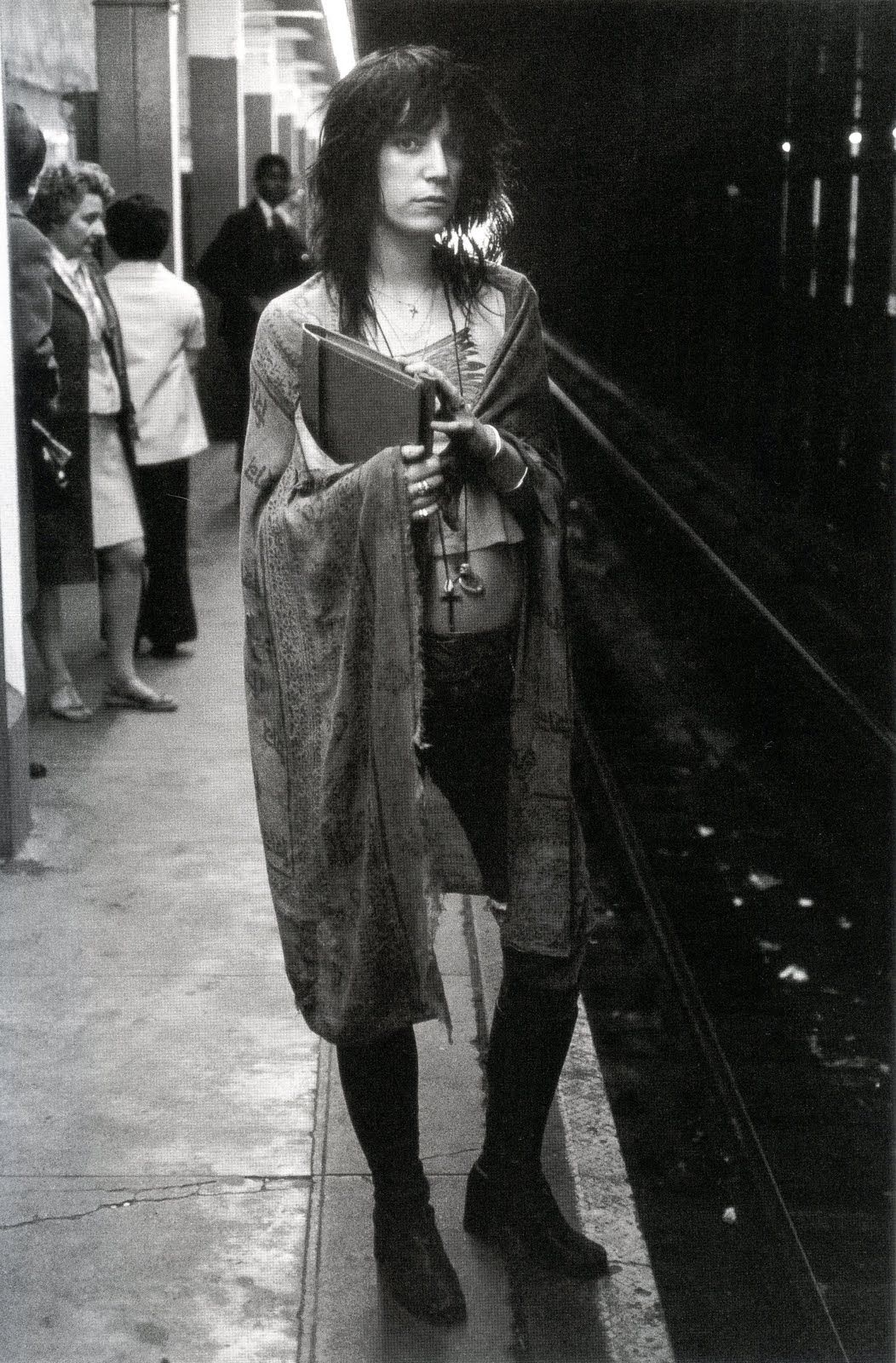
Selected Patti Smith videos (interviews, performances, influences) and lyrics (PDF)
Selected Anne Waldman videos (you don’t have to watch all of the Ted Berrigan one)
Anne Waldman poems:
- “Fast Speaking Woman”
- “Battery”
- “Pressure”
- “Lady Tactics”
- “Notorious”
- “Musical Garden”
- “Empty Speech”
- “Queer Heart”
- “Light & Shadow”
- “& Sleep, the Lazy Owl of Night”
Anne Waldman essays:
- “Fast Speaking Woman and the Dakini Principle”
- “I is an Other: Dissipative Structures”
Joe Brainard, “I Remember” (pdf)
Question 1 : 300 words
Anne Waldman and Patti Smith (in her interview) seem to describe very different views of what they think a poet is or should be, though they share an affinity for Arthur Rimbaud and several Modernists (such as Celine and Cendrars among many others). They also, obviously, have very different performance styles. Using (and quoting from) Waldman’s essay “Dissipative Structures,” write a few thoughts on how you feel Waldman’s and Smith’s poetry relates to aspects of ritual, the self, the body, and so forth, as Waldman describes. Pick lines from their writing (or moments in their performances) that you think embodies this. Be sure to point out moments where you think they diverge, particularly in how they express their feelings about society, values and a new of image of the female artist.
Question 2 : 150 Words
How do you think Patti Smith and her band transformed songs such as “Gloria” and “Land of a Thousand Dances”? Why did she base her songs on these hit tunes? Is there a way that she is trying to destroy the tunes (like she seems to want to destroy certain values)?
Question 3 : 150 words
Thinking backwards to Frank O’Hara and Allen Ginsberg, is there a connection you can see to what they were doing (formally, in terms of content, the views they express) in their poetry and what Ann Waldman, Joe Brainard, Bernadette Mayer (and if you want, Ted Berrigan) are doing in theirs? Is there some way to generalize what a “2nd Generation New York School Poet” likes to do?

 New York Underground in Film, Music and Literature 1955-85
1/Personally, I think Anne Waldman and Patti Smith differ from each other dramatically. I will use their poetics as a stem for my argument, and try to quote some segments of their poetic writing or actual performance as evidences. As it is indicated in the prompt, the two poets are majorly linked with their affinity of several great figures of modernism, especially Rimbaud, whom the two poets directly quote speaking of their poetics. To be more specific, as we describe it in the case of Bob Dylan in our class, the two poets appreciate Rimbaud, although not so much articulated so much in their poetics, because of their shared rejection to the formulated structure of society. Waldman puts this point in another way, quoting the theory of Helene Cixous (her surname is spelled in this way I guess…) in order to a feminine writing that stands against the masculine domination, or simply, that opens up new possibilities for artistic and political mobilization (134). In terms of Smith, the title of interview already makes her idea clear, that poets don’t make money, which definitely goes against the grain of the property/capital accumulating society. Moreover, the two poets adopt a strong consciousness of being woman. “Fast speaking woman” overwhelmingly defines the poet, shifting from a woman to “the woman,” the Woman as a race according to the poet herself (35). In her interview, Smith also underlines her spirituality, which is not at all dissociated with her bodily feelings, despite its divorce with materiality, indicating more complex interactions other than cartesian split of body and mind.
However I think for the rest, the differences between the two poets are more prevalent in my eyes. The two poets emphasize different aspects of Rimbaudian poetics, which leads them to totally different mode of expression. For Waldman, Rimbaudian notion of “dissipative structure” is especially attractive to her (127). She emphasizes on the fact the passivity of the poet him/herself as a spirit medium (133), which should remain a mute vehicle welcoming all the sensational feelings and spiritual sparks from both the actual and spiritual world. She then adds to that mysticism from different culture of different historical period. Contrary to that, what Smith is doing with her poetry and music is focused on the personal devotion of the poet, that is, the experimental mutilation of the poet’s physical body for the sake of the sharpest and also most secrete sensations of extremity, as well as the startling visions coming out of the body of the self-made monster. This is the reason why for me Waldman doesn’t engage her body so much in her literal creation, despite her physical movements during her performance and the presentation itself as a whole; on the other side, for me Smith is more physically engaged and creative as a visionary seer.
2/As I have suggested in my answer to the first question, I personally regard Smith as more actively creative that Waldman who nominates a lot or often turns out to be conceptual. That is to say, for me, Smith, instead of rejecting the oppressions (mortality, capitalism, social formality, patriarchy, etc.), she sets out to create the visions who can stand up as an independent and self-sufficient aesthetic/moral alternative. In other words, I think that the hip tunes in both of the two songs represent not her attempts to destroy, though indeed they are subversive vis-à-vis the original versions, but more importantly a new order of the music. Just to take the example of “Gloria,” Smith quotes the original version, yet doesn’t buy at all into the logic of heterosexual male dominating figure, who appears to be rebellious only because of their feeling of dissatisfaction (to something, we don’t know) instead of a well developed critique against the reason for the dissatisfaction, that is, the actual power structure causing the pain. On the contrary, in her version of Gloria, Smith really glorify herself by blasphemously claims the her sin as her own suffering that can’t be surrogated by Christianity, and also by her proud claim of a heterosexual adventure between female figures. In this way, the glory belongs to Smith, not because she dares stand up and roar and destroy, but because she manages to envision an alternative of life that she really dedicates to.
3/Generally speaking, I think what is special about the first generation is the fact that they live in the immediate shock, frustration and nihilism after the great war. The poetry of both O’Hara and Ginsberg demonstrates this symptom of nothingness, which often echoing with the voices on the other side of the Atlantic, notably the existentialist figure such as Albert Camus. Their works are often community-oriented: O’Hara pays much attention to interpersonal relationships within modern urban settings, and Ginsberg, despite his broader and more abstract geographical location for his poems, engages indeed in his contemporary political/ideological debates with his writing. The first generation is not overtly violent; the poets often express their deep frustration and despair within their poems, yet in the end, as if the paper locks the sound of the letters, they cover their swears and curses with their retreats, probably due to the trauma caused by the war just happened (or still going on). In terms of the second generation, I think that they first of all stand out and demonstrate the violence directly. Or as Smith explains with her performance in memory of Rimbaud, she is trying to transform the violence committed and suppressed in the past with her own art. Moreover, the outspoken violence also probes into the existential nihilism, asking if we have indeed lost God, what should we do next. The self-definition of the fast speaking woman, or the vision surrounding Smith’s horse may be the answers.
LikeLike
1.Anne Waldman sees her poetry as a stand in for universal experiences many women are going through. She describes poetry as “language ritual” in which the poem “manifested out of my voice and body” (128). According to her description, poetry is a ritualistic, communal process: “I am interested in extending the written word off the page into a ritual vocalization and event, so that ‘I’ is no longer a personal ‘I’” (128). Her work is not meant to be reserved to her individual, published accomplishments. Rather it is meant to be a physical, oral process that extends to an audience. She employs a scientific description of poetry, as transforming and changing, taking in and releasing energy. She is also concerned with old cultures from which she can learn and borrow.
Patti Smith’s interview reveals a more individual nature to poetry. For her, art was a “revelation,” a way to “get back to that freedom” of her childhood. She describes herself in more spiritual terms when speaking of her childhood, as someone who had the ability to connect with animals and nature around her. She was “spinning like a dervish,” in tune with a mystic spirituality without effort. However, she explains that society pushes a person back to the corporeal and returning to that childhood sense of freedom now requires work. Learning to write poetry and finding music was her way of returning to that. A few of her lines from “Rock N Roll” capture this desire: “Outside of society, they’re waitin’ for me/ Outside of society, that’s where I want to be.” She implies in her work that there is another community, one that is also frustrated with “rules and regulations” and seeks to be free from them. She says at one point that she wrote to the rhythm of classic American rock, like the Rolling Stones, but in her own language. Like Waldman, she is inspired by others. However, I think her focus is more individual. In her performances of her punk music, she is more communal and communicative with the audience. They both writing against the geemonic structures present in society, but I find that Smith is louder (just as punk requires) and in tune with her personal progress. Waldman is more communal and explorative of other conceptual fields.
2.Smith is destroying the themes prevalent in many hit, popular songs, themes of hypersexuality as expressed by heterosexual men. She is rewriting the sexualized image of a woman to equate to more than physical pleasure. She replaced Morrison’s “I’m gonna shout it everyday (GLORIA)/ Yeah-yeah-yeah-yeah-yeah/ Looks so good (GLORIA) alright” with “And I’m gonna tell the world that I just ah-ah made her mine.” She is taking pride not in the sexual victories of the night, but in the possession of another person, of being with someone that society does not uphold. Together they can sin and own those sins instead of accepting the salvation of Christ. Anyone attempting to stop her from pursuing her complete freedom, warning her with the words of God is pushing “Rules and regulations” that she does not care for, that she actively seeks to disobey.
3.Looking back at Allen Ginsberg’s “Howl” and comparing it to Joe Brainard’s “I Remember,” I see many similarities. They both use long lists that begins with the same words to recall a time when they were young. They jump from one place to another without warning and have odd, psychedelic descriptions of their memories. There are colors, hunger, and sexuality. Ginsberg describes the “best minds” of his generation as “looking for an angry fix,” “hallucinating” and “hungry and lonesome through Houston seeking jazz or sex or soup.” They are in a constant state of hunger, for food, sex, drugs, and music. They linger in streets and unknown places and well-known locations around the world. Brainard write about remembering several “sexual fantasies” involving the men of his childhood. He also recalls “dark red fingernail polish” and rose bushes as “practically solid red.” His memories are more solid and root from childhood, not adulthood. But he follows a similar pattern of recording them. To offer some generalization, I think these writers seek an honest, free-flowing description of their memories, an honest record that follows their natural way of writing rather than fitting into traditional poetic devices.
LikeLike
1. I felt as though both Patti Smith and Anne Waldman use their poems to explore the self, but Waldman appears more interested in exploring the physical body. Her poem “Skin Meat Bones” has the obvious emphasis on the body, in particular bones, while “Fast Speaking Woman” has mention of bones, mouths, tongues, cannibalism and rotting. “Queer Heart” references oral sex and “flesh burning” repeatedly. Meanwhile, Patti Smith explains in the interview a more outward view of the self, not focused on the body but on the “telepathic” connection she had and lost with the world around her as society bore its weight down upon her. Both poets seem interested in spirituality, but Patti Smith seems to focus in on Christian values – She says that she grew up reading the Bible, and her songs such as “Gloria” include lines like “Jesus died for somebody’s sins but not mine,” while “Easter” references, of course, Easter Sunday. Waldman’s spirituality encompasses a wider range of mysticism in her poetry with references to a self-made spiritual canon such as at the end of “Skin Meat Bones” when she says “in the name of all female deities.” I feel that perhaps due to the difference in medium that the two are functioning under, the way in which they express their identities within womanhood, especially as those rebelling from the norm of the female gender role, is different as well. Namely, Anne Waldman appears to have a raw anger in her voice and a rebelliousness in the graphic nature of her poems and the outspokenness of her femininity as encapsulated by such rebellion, while I feel that Patti appears to be less overt in speaking about her womanhood and there is less overt anger in her performances, and rather she is subverting expectations placed upon her by rejecting female gender roles; dressing more masculine in the “Gloria” performance, taking songs about women initially performed by men and singing them, and subverting the very idea of the norm of music and tearing down the expectancy for what music should sound like. Waldman’s an embracing and redefining, while Patti Smith feels more like a rejection and rebellion from.
2. Patti Smith comes across as attempting to break free from society’s expectations placed upon her and free herself from these constraints, as she talks about in the interview that we watched, saying that she did not even want to learn grammar when she was young (which is perhaps the most example I can think of of strict and sometimes arbitrary rules placed upon creators, for better or for worse). I believe that this is seen in her music too, by “reclaiming” previously written music and taking it for herself and then recreating it into something new. As the prompt puts it, she is trying to “destroy” the music similarly to how she is trying to destroy the norms placed on her, but I don’t think she’s trying to make the music sound bad, either, or do what she does for shock or to garner dislike. In some ways, it feels more fair to say that she is creating something new, rather than destroying anything. She’s trying to make it her own, outside of the expected conception of what music will sound like.
3. Perhaps it’s in part because we’ve been examining primarily female poets such as Patti Smith, Anne Waldman, and Bernadette Mayer, but the second generation of New York poets feel more vocally rebellious than the first. Looking back at O’Hara and Ginsberg, although there is a separation from the norm and a celebration of the counterculture it remains in the fantastic a lot of the time, and the subversion present is in order to create a romanticized portrayal of the underground. Smith, Waldman, and Mayer, and Brainard to a degree as well, come across as more willing to discuss a darker, gritter, more unpleasant reality. There are still many similarities, in that they are using free verse to explore realism but using a significant amount of surreal imagery to paint landscapes of the underground counterculture, but there is a more vocal and angry rebelliousness that appears present rather than the surreal dreamlike atmosphere present in poems such as “Howl.”
LikeLike
I feel Waldman and Smith both appreciate and acknowledge that poetry is an art, and with that it is not an easy art to achieve. In Smith’s interview, she explains how she does not crave material things but rather expand her mind. Through this way of life Smith becomes more appreciative of her work and is able to create poems and art out of passion and not in order to sustain her lifestyle. She continues on by believing in the act of recycling. She recycled her money, this ritual she followed from Rimbaud, she admits that he donated to Ethiopians and so she wants to donate to Ethiopians. Through her giving to not only unfortunate countries she also gives to people she can relate to. Smith’s rags to riches story is something many other artists go through and hope to come out on top. Smith recognizes the struggle and attempts to give back to people who may be in her old shoes. I also feel her introduction to the other members of the band shows how humble Smith is and how she recognizes that the other members may not be as known because they are not the face or the ones signing. Through the introductions smith continues the ritual or her belief that everyone deserves credit for their hard work. Waldman mentions something similar in her essay. Waldman says, “The leader is simply an extension of the group and is an embodiment of the collective and creative urge” (133). This acknowledgment of having more than one person the star represents unity and helps to create humble artists who understand that they could not have done it alone. Whether the two women pay tribute to Rimbaud or their team members they share their success with others and it helps send out a larger message of friendship and hard work. Despite being the stars both women use their power to help acknowledge smaller players or their own role models.
In her interview Smith recalls how as a child she was free and filled with imagination and endless possibilities. She continues on mentioning how she grew up and how society affected the way she thought about things. In similar words Smith says how society implements rules and regulations and all she wants is to get back to the freedom she had as a young girl. Through this idea that society regulated her own mind, I feel she attempted to transform the songs into something out of the norm. The songs had society’s acceptance and she wanted to break those chains and create her own music using the songs. By basing her songs on ‘hit tunes’ Smith continues to defy society by changing them and making them more blunt and risque. Through this she continues to expand her mind’ as she mentioned in her interview. I don’t think she destroyed the song, I feel as if she only wanted to make it more of her own and in order to do that she had to or wanted to go in the exact opposite direction of the song.
I feel O’Hara,Waldman, and Brainard are similar in the way they use the whole listing idea. In “The Day Lady Died” O’Hara lists his daily agenda. In the beginning of the “I remember” poem Brainard lists things he remembers. And Waldman lists what time of woman she is. I feel like a generalization of a “2nd Generation New York School Poet” likes to think outside of the box and break whatever things they were taught as a child. Smith does this through her remakes of songs. O’Hara does this when he creates a eulogy that barely mentions the dead women. I feel a lot of them are like Fenig from Jones street, when he wants to create his own genre of books. The second generation poets attempt to create their own style of poetry in order to be the best in that style since nothing else like it exists, since it’s the first time ever being seen.
LikeLike
Anne Waldman and Patti Smith both convey similar thoughts upon the ways in which poetry becomes a journey of discovering one’s self through a communal medium. Both artists utilize poetry as their method of speaking to a community and desire in altering not only a society’s conscious yet their own. A quick glance at both artists poetry suggests that these women focus upon breaking a hegemonic ideology of poetry for the public. However, a closer examination reveals that while creating a communal structure of poetry they simultaneously employ poetry as a method of reshaping an individual conscious.
As Waldman challenges the misconception that poetry becomes a closed and intimate medium of communication she creates an open space. By integrating her thoughts upon poetry as an oral ritual she states:” how I use it out of this female body and awareness to change my own consciousness and that of the people around me”(128). In doing so, Waldman explores the capability of poetry to simultaneously reform a singular and public consciousness. As she voices “own”, Waldman reflects upon the ways in which poetry revolves around self. The poet herself possesses the agency over the poem and allows it to shape her conscious freely. By allowing the poem a free entrance into the modification of her thoughts, the poet additionally indicates poetry as an open-space. Suggesting that it becomes an on-going medium, which holds the ability in continuously altering the self, and consciousness among generations and globally creating a communal experience.
Furthermore, as Patti Smith explores poetry through different channels such as rock, she intertwines rhythms of music with poetry and creates an open space of liberation. As the rock star describes her methods of writing she reveals her interest in listening to the rhythms behind songs and creating her own story out of them In doing so, the poet indicates that despite the abnormal method of poetry and weaving together rock this is where Smith locates the self. Smith creates an open space through rock for the public to hear her own poetry through an uncommon medium. Similar to the ritual processes that Waldman experiences while writing poetry, Smith voices her own methods and further reveals that the two are not too different. By integrating these methods it becomes evident that poetry through altering ritual methods allows reformation of one’s conscious to assist in understanding the self and the public.
(2) Patti Smith and her band alters famous songs as they increase the tempo of the original and create their own version in fast-speed. By picking at songs such as “Gloria” and “Land of a Thousand Dances”, Patti smith creates a distinct sound. Furthermore, Smith cultivates an alternative story compared to the original sounds. By basing her songs on these hit tunes the singer revisits the previous conscious of that era and reframes it to her modern-day. She centers her songs around almost monologue statements, unlike the original versions. In doing so, she implements poetry within her songs allowing for an open-minded listen. Smith in some ways is attempting to destroy the original versions. By destroying the original versions she erases the close mind that becomes associated with the hits. Rather, as she breaks them she creates an open sound for people to not only listen to yet possibly recreate and break themselves. Allowing for an open space of change and reform.
(3) Frank O’Hara created poetry that at times seemed comical and strayed away from the ideal format of structured poetry. O’Hara’s focus upon more recent events such as the death of “Lady”, and his expression of how he reflects upon that particular day cultivate a sense of communal sentiments. Similar to Waldman’s’ desires in using poetry as a means of having a larger conversation, O’Hara exposes these events to the public in the same fashion. Waldman’s inclinations for a communal experience through poetry becomes visible as she states:” I am interested in extending the written word of the page(128).” By sharing her desires in seeing poetry stem beyond the closed page it becomes written on, she can become associated with O’Hara of whom shares Lady’s death as an event that all remember yet he voices it. Both authors in separate ways utilize their poetry as a singular voice which is meant to create larger conversations. “2nd Generation New York School Poets” seem as if they generally utilize their poetry as a form of civil disobedience and protest, while O’Hara does not explicitly do this, Waldman increasingly desires in opening the eyes of herself and others around her.
LikeLike
1.
Patti Smith and Anne Waldman think very differently about the production and performance of art: Many aspects of the two’s thoughts on poetry seem diametrically opposed to each other.
The two take very different approaches to being female artists. Where Waldman says “I was focused on my own femaleness, and by extension, any woman’s” (36), Smith says “Most women writers don’t interest me because they’re hung up with being a woman … These women get so caught up with their heritage that they can never really spiral out.” Considerations of female identity (or identity of any sort) appear to have no place in Smith’s creative process – an aspect that is likely connected to her androgynous presentation of herself – while Waldman’s is arguably entirely based on the same.
Perhaps most evidently, Waldman is overtly spiritual; she considers herself a shaman, a medium through which poetry flows – she defines the process of writing as being “in the grip of a poem” (Waldman 137). Smith, on the other hand, takes much more ownership of the work she produces – implicit in her words “My mind, my imagination, my energy is … the most valuable thing to me.” Although she mentions reading the Bible as a child and references its content in her music, spirituality does not seem intrinsic to her work: It could not be, as it would adulterate the process of creating art.
Waldman and Smith also come from vastly different backgrounds. Waldman is defensive in her self-description in “Fast Speaking Woman & The Dakini Principle” – understandably, considering her privilege and the cultural appropriation that is the bedrock of her art. Smith, on the other hand, is unabashed and unapologetic, even in her own appropriation of others’ work.
On that note, appropriation is something Waldman and Smith have in common – the two both locate themselves in artistic traditions and draw freely upon their predecessors’ work to fuel and construct their own. Another thing I thought they might share is the desire to make ‘I’ “no longer a personal ‘I,’” as Waldman says is among her goals. That line felt reflected in Smith’s cry of “You! You are part of this too!” during a live performance.
2.
Smith and her band turn Van Morrison’s “Gloria,” an evenly paced song that’s repetitive in a catchy way into one that layers in a narrative, and grows increasingly frantic and fast through its duration. Smith expands a lot on Van Morrison’s lyrics, infusing quite a generic song with her trademark individualism.
In another interview with Smith, she spoke about doing art “because you have to, because it’s your calling.” It’s possible she chose to revamp a hit song like “Gloria” because it called to her, rather than for any specific reason or to prove a specific point, especially since she really doesn’t seem to care what people think of her or get out of her music. Smith’s version of “Gloria” is harder to digest, which may or may not be intentional on her part. It’s far less bland, and its narrator has a distinct personality. Also, taking something bland and unobjectionable and giving it anti-establishment undertones just seems like a very punk thing to do.
3.
With the given poems, it’s difficult to isolate defining features of a “second-generation New York School poet,” especially in the context of first-gen New York School poets. It feels to me like Ginsberg and O’Hara had very different priorities from Waldman and Mayer not so much because they were different generations, but because they were different genders. However, it does seem likely, given that the ‘60s was the hippie decade, that spirituality of the sort Waldman displays saw a great rise from the first generation to the next. It was oddly refreshing to see the well-punctuated lines of Brainard’s poem. It felt a lot less breathless and chaotic than “Howl” – there was more of a melancholy to it. But his calmness and vague nostalgia strike such a different chord from Waldman and Mayer’s work that it’s extremely difficult to find something generalizable to say about their generation of poets.
LikeLike
1. It seems to me, both Patti and Anne have similar ideas when it comes to what they believe poetry should be about in terms of content. Though what they ascert a poet should be seems to be different. It seems that both had great admiration for Rimbau, who both cite extensively. For Patti, she really, in her interview, emphasized that money was not very important for her, and admired poets for not making any money for their art. Patti’s poetry, and even Anne’s seem like big poems, big, not in length, but just in shear size of the society they are taking on. You feel they are both going up against the constraints put on women, and the social values of the day. Waldman talks in her essay of having to actualize that state of mind. It really speaks to how she uses her poetry. Which feels like they need to be sung, or at least transfixed into song, like Patti Smith did with her poetry. But as Anne says, the music is already there inherently. Her poem “musical garden”, is one that really emphasises that chant or big social justice charge she’s trying to make. And reminds me a bit of Allen Ginseberg and Whitman, in how they both just list things, while keeping a similar rhythm throughout their poem. Smith’s poetry seems to be a bit more aggressive, or maybe just since we see her performances which are delivered with much passion and conviction, it just feels that way. But especially “horses” is a pretty physical poem, that is quite provocative in parts. Patti seems to be a bit more brutal in her expression of social disobedience, for instance the line in Horses, “He picked up the blade and he pressed it against his smooth throat(The spoon), And let it deep in (The veins)”. I assume she’s echoing the drugs and sensual life many were living at the time.
2. I think that would be an interesting possibility. It is pretty apparent Patty has a dislike of most of american life. In her interview she spoke of how most of life is trying to shut out the childlike imagination you have, and forces you to conform to societal expectations. I think that in choosing a song that caught a mainstream audience, it enabled her to break into their ears in a way. Or, she sees these songs as pillars in the american cultural establishment, and in turning those tame pieces of pop into something much different, she is symbolically taking down that very establishment. Especially a song like Gloria, which is just a love song, and then you hear, “jesus died for somebody’s sins but not mine”, and turns this girl Gloria that Van Morrison was talking about into this dirty or uncouth type of personality that was provocative at the time.
3. It’s interesting how a lot of these poets at the time list things out. They really just seem to describe certain scenes and place up against each other, without really giving a context or even an explanation. Just sort of holding up these scenes in a way of saying it’s happening. Really it seems that mainly, there views were part of the counterculture going on at the time, and gave voice to those in that part of America. I guess in a way to generalize what they do, is that they use their voice to give voice to a way of life, many didn’t really understand.
LikeLike
1.Patti Smith explains how art gave her the freedom that society had dispelled with its rules and regulations. In her interview, she says that did not want to go to school to learn grammar, but wanted to be able to write a sentence so she studied Henry Miller, Mickey Spillane and Rimbuad. While learning to write, she developed an interest in poetry. Patti says “poetry was the most releasing drug for me” (Patti Smith Interview). Smith used poetry as a release and to free herself and her mind. Waldman on the other hand, used poetry to be “linked to those dancer-shamans in the Paleolithic who identified themselves metaphysically with the untamed creature that were their sustenance” (Waldman, 129). Waldman felt that poems were within her, waiting to be released. When she creates a poem, she says “It moves through me. Then it takes a shape on the page…” (128). Watching Waldman perform, “Fast Speaking Woman” the audience can see the poem move through Anne as she gesticulates. Her performance is an engaging visual experience in addition to being a captivating audial experience.
Waldman is not outright against the foundation of society, like Smith. Smith explicitly says that rituals and rules of society limit the freedom of the mind and body. Waldman, in contrast, explains that she needs “energy fields” which can further her poems (133). She goes on to say that “a rite, religious or secular, is an action redone, a commemoration of an original efficacious event, and yet if performed properly, it recharges the original event,” (133). Waldman is inspired when societal events are recreated and recharged. Waldman needs society and structured rites and acts to expand her mind and create poems.
Waldman also focuses on the empowered woman. Explaining that the “essence of woman, the uncompromising nature of female energy” is a powerful tool.
2. Patti Smith based her songs on hit tunes because she needed inspiration. In her interview, she said she studied rock n’ roll to get herself into a rhythm where her “word and body connected” (Patti Smith Interview). Smith was intent on letting herself be free and her imagination run wild. Society tried to crush her spirit and limit her mental freedom with rules and regulations. Smith’s best poetry and lyrics flowed from her when she was uninhibited. I think Smith mainly listened to rock n’ roll to free her mind from the constraints of society and “Gloria” and “Land of 1000 Dances” influenced her so much that her lyrics for “Gloria” resembled Van Morison’s “Gloria” and her melody for “Horses” was similar to “Land of 1000 Dances”. I do not think she wanted to destroy the tunes, rather she needed a tune to fuel her imagination. When she wrote “Horses” she wanted to transform the original message of “Land of 1000 Dances” to explain the lasting burden of a trauma like rape. “Land of 1000 Dances” is about a woman being raped and has no real message. Whereas in “Horses” the young boy who is raped, “The boy took Johnny, he pushed him against the locker /He drove it in”, realizes he cannot live with what has happened so he kills himself with his shiny blade “He lay, pressing it against his throat” (Smith).
3. The 1st Generation of New York School poets included poets such as Frank O’Hara, who enjoyed mixed art forms. O’Hara’s loved socializing with artists and his poems reflected his reverence of paintings, as his poems were very visual. Allen Ginsberg was another prominent poet of the 1950s. He focused on highlighting the marginalized members of society. Ginsberg showcased his view of society through his poem “Howl”. “Howl” was intended to be a social criticism and Ginsberg wanted it to instigate political change.
The 2nd Generation of New York School poets were more focused on freeing the mind and body. From Waldman’s desire to align her energies and create poetry, to Mayer’s use of stream of consciousness narratives, ones’ own body and mind were prioritized among 2nd Generation poets. The 2nd Generation was more in line with ideals of the flourishing rock n’ roll movement.
LikeLike
1. Smith and Waldman have as many differences as they do similarities. In terms of their performances, they share a similar view on the connection between the poet’s physical body and her poetry. In an interview, Smith talks about how she studied rock and roll bands such as The Rolling Stones “to be able to get [her] into a rhythm where [her] words and [her] body connected.” To Smith, the performance aspect of her poetry is just as important as the words themselves. Waldman seems to have the same view. She writes, “I enter into the field of the poem with my voice and body. The poem that in turn has manifested out of my voice and body. There is a reciprocity of energy involved.” Waldman, like Smith, connected her body to her words, and they fused to create a more powerful poetic experience. To the two poets, word and body are indivisible.
In her new interpretation of the song “Gloria,” originally sung by Van Morrison and them, Patti Smith takes a political stance against patriarchal views set forth by popular music. As she distorts and reinterprets the lyrics of “Gloria,” she gives them new meaning and new perspective. In her revision of the original song, she solidifies her place as both an artist and an activist. Waldman takes a different route in her pursuit of feminism. Instead of satirizing patriarchal pop-culture, she expresses her femininity in unique and creative words. In “Fast Speaking Woman,” she owns all different sides of her femininity, becoming the embodiment of many different kinds of women across a multitude of cultures. Perhaps her identification as “the average woman” best describes her stance throughout the poem. Although women are all different, we share a common bond in our feminine energy.
2. Patti Smith took the original “Gloria” song and satirized it, going so far as to quote several lyrics from the original song. These quotes include she “looks so good” when she’s “walkin’ down the street.” Smith goes even further in her satirization of Morrison’s domineering tone as she sings, “I’m gonna make her mind / ooh, I’ll put my spell on her.” By using the same song title and some of the same lyrics as Morrison’s hit, she calls attention to the overbearing, patriarchal tone used in so much of modern popular music. By transforming the song and making it her own, she also takes back a lot of her power as a woman. Instead of submitting to such a tone, or even fighting back against it with original lyrics, Smith used her artistic creativity to subvert the lyrics and call attention to them creatively.
3. The main difference that I see between the first generation of New York school poets, such as Alan Ginsberg and Frank O’Hara and the second generation, such as Anne Waldman and others is that while the first generation challenged the form and content of poetry itself, the second generation challenged societal views with the use of their poetry. Ginsberg’s “Howl” contained content that many deemed vile, but it has since become a beacon of how poetry can evolve in terms of subject matter. In “Rock and Roll N****r,” Patti Smith sings, “outside of society, that’s where I want to be,” in a clear and explicit objection to modern society at large. Both generations of poets contributed greatly to the evolution of modern poetry, although their specific objectives and motives were quite different.
LikeLike
1.Although Anne Waldman and Patti Smith share obvious performance differences and clear separations in ideology regarding the description of what they think a poet is or should be, I believe they diverge on more aspects than one might think. Indeed their performance styles are clearly different. Smith in her interview stated that poetry is her “drug” and a “release” method for her. This characteristic is clearly visible in many of her performances in which she seems to let her creativity dictate the flow of whatever song or poem she is reciting. In other words, Smith’s performances seem to progress with how she is feeling resulting in more spontaneous events. An excellent example of this is when she busts out a guitar riff and begins shredding the strings as if in a spiritual trance. Waldman’s performances in comparison seem much more scripted. Both in her live recitals of “Fast Speaking Women” and the piece on “Bones” have a really specific rhythm. Both cases showcase a heavy emphasis on the words “woman” and “bone” respectively, giving off a very clear indication of rehearsal to me. To me, both performances are poetically beautiful with equal bits of dramatization to engage the audience; however Waldman seems to hold a bit more organization while Smith seems to disregard order all together. It is no surprise that the latter is regarded as a founder of punk culture. With that said, there are many aspects in which they cross paths–specifically when it comes to creating experiences with their poetry. Both poets seem to agree that as poets they are to create said experiences to share with the world. Smith obviously is all about using her raw feelings and emotions to convey this. Waldman, similarly states in her essay “I Is Another: Dissipative Structures,” that her performances should “actualize” a certain state of emotion. Waldman further builds upon this idea of actualization stating that her performances often needs to provoke certain feelings of fear or anxiety to better convey more disturbing horrors occurring in the world. This rather “shock” characteristic definitely fits in line with the ideals of Smith who in fact twisted many classic songs to fit a more rebellious punk vibe.
2. I definitely understand why Smith chose “Gloria” to be the base of her transformation song. For starters, it fits her religious persona perfectly. Compared to the original there is a very clear sense of individualism to me especially because she is a woman. The piano solo opening of Smith’s version is what definitely gives off this feeling. Furthermore, there is definitely a rebellious vibe in the performance of the song itself compared to the original version in which the singers are relatively adamant in their stances. They seem to have a very “gentleman”-esque take on the song. Smith sings with a rough and fierce face with dynamic emotions and gives a very raw performance. Indeed this may look as if she is trying to “destroy” the tunes, however I think this is simply how she feels the song should be sung. As I stated in question one, Smith is an artist who cares a lot about the experience her work creates and how her messages are conveyed to audiences. While the song “Gloria” tackles social issues regarding the female gender–specifically their independence, hence the line in which Smith boldly claims that “Jesus died for somebody’s sins but not [her’s]–I think the singer only wishes to destroy said
3. There is definitely a connection between these two generations of poets. To me personally I feel that Frank O’Hara’s ideas that poetry is not mechanical in nature and rather based on human instincts is exactly in line with the creative and relatively spontaneous thinking of Patti Smith. This view of instincts and going of feeling is a resonating idea across both generations in which I believe can definitely be used to generalize this “2nd Generation New York School Poet”. With that said, Allen Ginsberg, “Howl” touches on the poet’s value for voice and identity. If you recall said poem itself, there are many line breaks and repetition that create identity. To me, this is a perfect relation to Ann Waldman and her value for experience and performance. As stated, I feel Waldman’s performances are very scripted and are meant to convey certain messages in specific ways in which she predetermined. Combining these ideologies together, I personally would generalize this “2nd” generation NY poet as one who likes to base their work on raw feeling and reactionary emotions, while creating meaningful experiences through performances that engage the audience to better understand the messages they wish to convey about current social issues.
LikeLike
1
Anne Waldman and Patti Smith’s have vastly different poetry and styles of delivery, yet often their work relates to self-identity. Both poets share an affinity for Arthur Rimbaud, and when inspecting their bodies of work it is evident this affinity can be attributed to Rimbaud’s investigation of language, verse, and the self. “The poet is truly the thief of fire…he will have to have his own inventions smelt…this language will be the soul of the soul, containing everything,” Rimbaud writes. Indeed, one can find both Waldman and Smith’s souls in their poetry. The poets have distinguished angles through which they view performance art, but both focus their efforts on conveying mindsets and illustrating perspective.
Waldman’s dramatic performance of “Fast Speaking Woman” incorporates vocal inflections to slow and speed her tempo, much like a musician. Her animation is evident when raising her voice saying “High pitched woman,” and when she says “hissing woman” she draws out the ‘hiss.’ There is no repetitiveness to her speech, as the rhythm she establishes keeps things dynamic. Her performance relies heavily on physicality, but a different physicality than Patti Smith. Waldman maintains a constant swinging from side to side, adding kineticism to her speech, and her hand movements, complemented by theatrical facial expressions, reveals the soul she puts into her work.
Patti Smith’s performances are the archetypal punk artist. She even prefaces one show by stating, “you shouldn’t be afraid of this instrument. It might sound real horrible…and it might look a little threatening…but this is what we traded for bayonets. This is our instrument of battle.” This encapsulates her stage presence, as her vibrant personality fights for independence against the shackles of society. Shouted delivery and maverick lyricism is characteristic of her performances, emphasizing the self and individualistic expression.
Smith mentions Rimbaud in her interview, stating she connected to Rimbaud’s poverty. “Poets don’t make money…I make money because I work night and day…when I was a young poet I had no money and I became a pickpocket. You do whatever you must do to keep doing your art, but you never sell your own art.” Smith places value on the self, but her idea of the ‘ritual’ is different from Waldman, as Smith seeks to preserve artistic expression and it’s value even through questionable means. Waldman, on the other hand, sees the ritual of her work as specifically going against the “masculine domination…opens up new possibilities for artistic and political mobilization.” Though both poets diverge in terms of delivery styles and ritual in writing, they share a passion for the self and finding one’s voice.
2
Patti Smith’s covers of “Gloria” and “Land of a Thousand Dances” reinvent their originals by adding anti-authoritarian messages and upping the tempo to create rousing punk anthems. In Patti Smith’s SRF interview, the artist states “all my life I liked to study the Bible…as I got older society ingrains you, rules you, they take away your telepathy and push you inside your body.” This lends clues to her decision to transform songs like “Gloria” and “Land of a Thousand Dances.” The original songs have innocuous lyrics and innocent messages, and her covers add lyrics that rebel against the “ingrainings” of society. The anti-religious messages of “Gloria” and yearning for transcendence in “Land of a Thousand Dances” eradicate the song’s original meanings and replace them with her own desires to break free, and get out of her body. “Gloria,” particularly, has the strongest change. The original song by music group “Them” is an ode to a speaker’s love, whereas Smith’s rendition uses the same chorus, “here she comes,” except in this context it lauds her independence from religion and personal ability.
3
Frank O’Hara and Allen Ginsberg were focused on subverting their contemporaries by writing pieces that focused on the relationship between speakers, with the literature “existing in a plane” between them. This is “personism,” a term coined by O’Hara, which emphasizes stream-of-consciousness writing and a focus on intimate details. Their poetry is connected to Anne Waldman, Joe Brainard, and Bernadette Mayer, as both focus on capturing the imperfect self, and by extent the time, rather than poetic whimsy or fanciful descriptions.
A link can be found in an excerpt of Brainard’s poem, “I Remember.” This poem is full of intimate details, such as “I remember wanting to change my name to Jacques Bernard” and “I remember (stoned) when the most profound thought in the world totally evaporates before you can find a pencil.” These details retain a sense of humor, relatability, and self-awareness, in some cases even self-deprecation. They capture the human experience and the minutiae that is our life.
A “2nd Generation New York School Poet” typically seeks answers to philosophical questions with quirky writing styles and playful wit. Waldnman, Brainard, and Mayer all share a fascination for everyday life that revolves around observations on the contemporary world and the insight that results.
LikeLike
1. As poets of the underground New York art scene, both Anne Waldman and Patti Smith both brought a performative aspect to their poetry, stressing the importance of this performance as sacred to both the poet and the audience. Waldman builds on the idea of “dissipative structures” to argue that the language of poetry connects the self to a past meaning or emotion, and that performance is what brings out that meaning or emotion. Waldman believes that “[her] words are empty unless they ‘connect’ with a field of energy that confirms or activates further the breath of the poem” (133). Patti Smith’s concept of poetry is related, although she doesn’t seem to build off of the idea of “dissipative structures”. Rather, in her interview, Smith details how her art was a way to connect to a more innocent, childlike version of herself. She discusses how, as a child, she would communicate with nature until society imposed its ideology on her. It is only in the expression of art that she is able to find that pure connection. Waldman’s ideas can be seen in practice in several of her poems and performances. For example, in “Fast Speaking Woman”, the poem is extensively repetitive, resembling a primal chant or ritual. In “musical garden”, Waldman describes how she “can’t give up” a variety of things, tapping into a primal, bodily desire while refusing to deny it. Patti Smith’s self-expression can be seen in almost any of her live performances. Specifically, the end of “Feedback and Poetry” is an emotional, harsh guitar noise that appears more expressive than musically technical. Although both of these poets stressed the expressive, improvisational nature of poetry, they diverged slightly in how their ideology. Where Waldman seems to want to tap into primal ritual and sacred tradition, Smith seems to want to connect with pure emotion or expression. Waldman’s ideology could be characterized as “external”, whereas Smith’s is internal. Regardless, both agreed that art was what allowed the individual to transcend their current state, and both pushed the boundaries of how female artists and artists in general were allowed to express themselves.
2. I found Patti Smith’s transformation of these popular songs to be very interesting for a couple reasons. Instead of doing a traditional cover, she seems to have dissected certain parts and lyrics of pop songs and integrated them into her own. The new songs are a weird mix of pop melody/harmony sensibilities and deeply poetic lyrics. By basing it on these tunes, Patti Smith is appropriating a piece of popular culture for her own use. This can be seen as a sort of “destruction” of the tune. By taking many of the elements of these pop songs and blending them with her own songs, the listener is reminded of the formerly-whole pop song, but must come to terms with whatever it is that Smith added. Perhaps Smith did this as an inverse of the loss of innocence described in her interview. In the same way that society took her values and blended its own with them, Smith is taking society’s songs and blending her own values in, thereby destroying them.
3. The “Second Generation” of New York poets definitely draws from many elements of poets such as O’Hara and Ginsberg. Formally, many poems seem to follow the “list” format, most notably seen in Ginsberg’s “Howl”. Waldman’s “Lady Tactics”, for example, follows a similar pattern of returning to a refrain every few lines (In “Lady Tactics”, it’s simply “she”). Furthermore, many of the views expressed among these two generations of poets are similar. O’Hara and Ginsberg’s acceptance and representation can be seen in poems such as Waldman’s “Battery”. Joe Brainard’s “I Remember” also follows a list format, but it is also very similar to a poem such as O’Harah’s “The Day Lady Died” in that much of the poem concerns ordinary, everyday events. Furthermore, poets such as Bernadette Meyer incorporate non-Western elements to criticize the traditional Western ideology. Overall, I would argue that “2nd Generation New York School Poets” are most concerned with connecting to others by rejecting the traditional Western narratives and embracing the “everyday” in all its forms, from the most disturbing to the most ordinary.
LikeLike
1.Though both Waldman and Smith define in their own ways the New York modern poet and share a similar affinity for Rimbaud, they clearly diverge in their approaches to poetry and, thus, their performance. When watching their interviews, both reference their affinity for Rimbaud and other modern poets. They seem to focus on these key figures as revolutionaries, poets who rebelled against society during their time in their own ways in the same way they do in their own time. They may not compose their poetry about similar topics as Rimbaud or have the same poetic structure, but their attitude towards society remains in opposition, just like his. They simply have a different kind of society which they rebel against, one further in the future than the post-war generation Rimbaud belonged to.
The most clear difference I saw when I watched the videos of Waldman and Smith were their styles of performance. While Patti seemed to let her poetry course through her body, creating a very violent and dramatic physical performance, Waldman’s readings of her poetry, while her body still moved, were considerably less dramatic. This seems to parallel each poet’s attitude towards what poetry is. Patti says in her interview that when she was young, she felt in tune with the universe, almost “telepathic.” However, society, rules, regulations, and political and religious dogma took this telepathy away from her and “pushed [her] inside [her] body.” When she discovered art, she discovered freedom. Music, to her, is a rhythm “where word and body come together” while simultaneously “developing her mind.” This view of musical poetry as a break of Patti’s soul from her body, freeing her from society’s constraints, shows in her violent bodily movements in her performances. It is as if she is escaping her body with her convulsing movements. Furthermore, her word and body seem to truly come together, as her body mirrors the turbulence in her words, such as in Gloria: “People say “beware!/ But I don’t care/ The words are just/ Rules and regulations to me, me.” Waldman’s comparatively still style of poetry reading is then a result of a different approach to language: “Poetry is not a closed system for me experientially… Life eats entropy. I am interested in the power language has, and particularly in how I use it out of this female body and awareness to change my own consciousness and that of the people around me. I enact language ritual as open-ended survival” (128). Throughout her essay, Waldman is concerned with language: its power to transform the female body and the intrinsic power words have on consciousness. Whereas Smith seems to be concerned with music and poetry as a means of freedom, Waldman seems more interested in the power and freedom within language itself. Thus, her physical readings don’t carry the physical signs of liberation like Smith, but carry energy which equals the energy of the words she delivers.
2. The song Gloria is actually a hybrid between on of Smith’s poems named “Oath” and the original garage-band song “Gloria.” More than half of Smith’s “Gloria” lyrics are her own, and the song starts with “Jesus died for somebody’s sins but not mine” (1). Throughout the song, Smith refuses to change the pronouns to refer to a man, which transforms the song into a lesbian, aggressive, and absolutely independent rendition of its original. She does a similar job with “Land of a Thousand Dances.” Both songs lyrics seem to center around freedom, sexual freedom, physical freedom, mental freedom. I think Patti uses these hit tunes as an avenue for her poetry as a kind rebellion against mainstream society. She takes hit songs and strips them of the mainstream lyrics, thus taking the freedom to “destroy” aspects of the song which made the song fit for society’s standards. This act of choosing a popular, mainstream song as opposed to an unknown one seems to be her act of rebellion against society, choosing to represent freedom and liberation instead of staying enslaved to the standards of mainstream society.
3.The poetry of O’Hara and Ginsberg seem full of nothingness, reflective of their post-war generation. They don’t sound like a violent rejection of their society, but rather a somber, serious kind of modernism concerned with the self, the self in relation to the world around it, an existential crisis typical of the first generation of poets who lived in a world post-war. They don’t attack their society, but express their frustration with their worlds in an existential, dark way. Waldman, Brainard, and Mayer have similar frustration with the societies they live in and express these frustrations in their poetry and music. However, their approach is more overtly violent and calls for immediate change. They refuse to cut themselves off from society, but rather see their dissatisfaction with it and their respective art form as a strong combination from which they can bring about change, or at least awareness. They use their grasp on language not to express frustration with life itself, but with the societal constructs and dogmas which limit their freedom.
LikeLike
1. Waldman’s work is more expressive and reaches into the human psyche quite deeply. As she mentioned in her essay, “I would agree that [poetry] is in fact four dimensional in its performance. ‘Performance poetry’ is a useful term I once resisted for its theatrical and entertainment implications” (140). The manner that she describes the performance of poetry extends further than the mere literary value, but hopes to “break the wall” of the fourth dimension. The reading and performance of poetry by its authors is supposed to be a highly personal “event” that pulls from every existing element. Waldman believed that minuscule aspects of daily life influenced the nature of her poetry, including “the time of night and day, the phases of the moon, the last-minute choices” (140). The audience is supposed to feel a sense of urgency regarding mortality and limited time that ultimately makes her poetry effective. Waldman is arguing that live poetry should acknowledge its purpose and value as a poem, while also digging at the audience’s perception on what it means to be human. She references gods and religious deities quite frequently and also argues that performance should be nothing less than the channeling of the inner spirit of the artist.
Patti Smith has an obvious preference for the stylistic elements of poetry that allow it to be rhythmic and appealing. In her interview she states, “I had to study Burrows, study Rimbaud and learn just how to make a sentence. I studied T.S. Eliot for his rhythm, his music, you know? I listened to Jejuka tapes, I listened to the tapes of barbers of like primitives… American rock and roll.” She modeled her style on the aesthetic or musical qualities of American rock and roll. Her performances were unique and expressive, though not as expressive as Waldman. As far as social beliefs, she begins, at 1:10 in the interviews, talking about how restricted she feels by social standards and beliefs. She expresses a feeling of social oppression that revokes the artistic qualities of each individual. Smith constantly chases her youth, and realizes her loss of innocence at the hands of social standards
2. Patti Smith brilliantly creates these loosely based covers to give a more contemporary look on the world around her. Here we can see the beginning of the shift towards anti-establishment thinking and a bit of a push on the patriarchy. By rewriting the most critical parts of the song she empowers herself an artist, proving how she is able to alter popular culture, or at least the perception of it. It seems as if she is creating a path for the proliferation of punk in the cultural scene because of her desire to change social structures, particularly the perception of women in the rock and roll/poetry scene. Ultimately, though, she does not want to destroy the songs. Considering her values and views on poetry she is focusing instead on shifting perspectives, as mentioned. Instead she wants to alter the views or attitudes towards the songs, while still being respectful of their artistic qualities.
3. While one can argue that this is the purpose and goal of every poet, both generations are largely concerned by the expression of human emotion. All coming from very diverse backgrounds seem to express common sentiments of loneliness and marginalization. Through very unique means they each provide their circumstances and situations that drove them to poetry. 2nd generation New York School Poets seem influenced by previous arts and poetry, attempting to reach deeper into human consciousness. The appeal is focused on visual arts and performances that shape live poetry. Fast Speaking Woman being an example of the shifting nature of New York poetry, displays the disregard for structure that was once present. As mentioned poetry became far more interpretive and complex, in turn “oral tradition” became far more essential in analyzing contemporary poems. Another important aspect of the 2nd generation is the expansion of feminine energy/presence in the poetry scene, giving a more well rounded view on NYC culture.
LikeLike
1 Patty Smith seems to be more concerned with how women are viewed via lenses portrayed in things such as popular music (which has got more misogynistic as time has gone on, albeit with notable exceptions), whereas Anne Waldman is more concerned with the body politic, the status and expectation that comes with the moniker ‘woman’ from coddling Melville and Hawthorne to the physical scars women carry. Waldman challenges the “woman never under your thumb, says/
skull that was a head,” or the idea that women somehow have less to say as poets or belong to the domestic experiences that can scar them (Fast Speaking Woman). Patti Smith revisits the source of the trauma in in ‘Feedback and Poetry’ when she says “I know its gonna drive you crazy, but you just put yourself back there in World War 2 or wherever you want” essentially rejecting the mythology of the past and the fetishization of violence and replacing it with noise. She does not try to ritualize it and process the trauma with pretty words, rather she reduces it to the base nonsense of a feedback loop, where the guitar feeds into itself like the military industrial complex. Figures like Patti Smith and even Bob Dylan were a part of a cultural industrial complex, becoming poets who were good at earning money as Patti Smith explains in her interview. This hang-up with money and successful artists in the new cultural landscape caused the art scene and the poetry scene to become less genteel as time went on, culminating in someone like Bob Dylan winning the Nobel Prize for literature at the same time in Rupi Kaur becomes one of the most popular poets in the world. The cultural job of poetry was changing rapidly and the spaces to express poetry were expanding into the airwaves and the back of cereal boxes and John F. Kennedy’s televised inauguration.
2 Rather than destroying the meaning of a song like Gloria (which barely has any meaning to begin with) Patti Smith elevated the song and used its platform to carry her message. I’m not trying to be anachronistic with my vocabulary, it is just the way I understand what she was trying to do. The original song is bland and tasteless, but popular. Patti Smith does not respond to the original, rather she owns it. “My sins my own/They belong to me, me” is a statement that is not critique and does not ask for permission. It takes on a life of its own and is not simply a cover. It is irreverent, in a way that songs addressed to Jesus Christ often are.
3 The so called “2nd Generation New York School Poet” are responding in large part to the evolving dynamic between the formalizing counterculture and the somehow increasingly dominant primary culture. As public perception became more aware of the issues they were addressing, figures like Barry Goldwater become larger than life. The figures of the new school were everything somebody like him was not: they were poor, women, queer, and people of color. That is not to say they were driven to the margin necessarily, but rather that they drew a new margin around themselves, to create the liminal space they needed to express themselves. Joe Brainard is nostalgic like Frank O’ Hara, but he is also more overt. In that sense, they can stand on the shoulders of giants and see more of the optics around them. They occupy new spaces and have more experiences in part because the way was paved for them and they did not have the same cultural baggage of the World War 2 and the aesthetic trappings of modernism.
LikeLike
1. Anne Waldman and Patti Smith are poets that differ quite dramatically in terms of what they believe a true poet to be. Patti Smith does not value anything nearly as much as she does her mind. Art seems to be the only thing that moves her in life and gives her a purpose, all of which she would not be able to produce without her mind. In an interview she stated, “As I got older society ingrains you rules, regulations, political dogma, religious dogma. They take aways your telepathy and push you inside your body . . . and all my life I’ve been trying to like get back to that freedom.” It is evident that Patti Smith values her freedom above all, and although both she and Anne Waldman both learned poetry through Rimbaud, it is also evident she rejected the societal structures implemented into our everyday lives. In “Fast Speaking Woman,” Waldman celebrates herself and women as a whole, “I’m an abalone woman / I’m the abandoned woman / I’m the woman abashed, the gibberish woman / the aborigine woman, the woman absconding.” Walkman focuses on the energy she delivers through her poetry, which is important in order for the performer to successfully become a sort of energy source that creates a separate experience from the poem itself and further develops the message being sent. Overall, Patti Smith seemed to focus more on the constraints of society in various forms — religious, political, capitalistic, etc. — while Anne Waldman’s poems seem to focus on women and rising against the social domination of men. Patti Smith’s own way of taking a stand against how society is being run and how she questions the structure can be viewed in her song, “Rock and Roll N….” the lyrics state, “Do you like the world around you? / Are you ready to behave? / Outside of society, they’re waitin’ for me / Outside of society, that’s where I want to be.” She does not write or perform because she needs the monetary compensation, in fact, she continuously states that money is not important to her. She is willing to give it away to the youth and aspiring artists because she does not view it as a necessity, it is something she has lived without in the past and can do again. I began this paragraph attempting to differentiate Patti Smith and Anne Waldman, but as I further developed my ideas, realized that they in fact do not “dramatically” differ as I had originally thought. Both of their art focuses on society and challenging its misogynistic foundation.
2. It is evident that Patti Smith used her music and poetry as a form to stand against society and perhaps even rewrite the past. In the case of “Gloria,” I felt that Smith transformed the song in a way that completely erased its misogynistic past. Originally, the song by Van Morrison does not seem to mean much more than the physical pleasure that Gloria brings to him, merely focusing on her sexual appeal and completely disregarding all else. Gloria is simply being presented as a woman that exists to satisfy his sexual desires. The song continuously alludes to the night they will be spending together, “I’m gonna shout it all night (GLORIA) / I’m gonna shout it everyday (GLORIA).” Patti Smith’s version completely transforms the meaning of the song in the first line alone, “Jesus died for somebody’s sins but not mine,” which was not even part of the original song. When she performs the song, Patti Smith begins it slowly and on the piano, delivering each line with sentimentality, and slow builds up into a more rock and roll tempo. A lot of the song is written by her and even parts from the original song are rearranged by her.
3. The “2nd Generation New York School Poet,” seems to use their poetry as a way of questioning the way society is being constructed and trying to redefine it, in a way. O’Hara, for example, seemed to include his personal life into his poetry in a way that sometimes made it hard for the reader to relate or understand it, giving only himself authority over his work. The first generation — O’Hara and Ginsberg — seem to focus on themselves and the feelings that New York caused in them, their poetry did not follow any rules and was a way for them to truly express themselves. Following them, the second generation uses their poetry to send messages, their work is understood by the public because it needs to I order to reach them. They use their poetry to express their irritation toward the way society is being developed. Through their art, they attempt to bring back a sense of liberation and renewal.
LikeLike
1. One aspect of poetry, or art and performance in general, that both Waldman and Smith regard with importance is the communal nature of their work. In her interview, Smith says that she would sit at her typewriter and listen to the Rolling Stones and get into the rhythm, but creates her own language out of it. This reminds me of the “reciprocity of energy” (128) that Waldman claims is involved in her poetic creation. Both poets describe their methods as a sort of altered consciousness where “some ‘other’ thing” (137) is involved in the final piece of art. Although they have extremely different methods of creation, the repetition of “habitual rituals” (136) is at the centre of both of their work. While both poets embody a “utilitarian sense” (138) in their art in regards to their positions in their society, Smith speaks more to her monetary contribution to the art community while Waldman seems to use her position to create a more “communal ‘I’” (128) to voice areas that have been previously quiet (135). In this way both of these poets have put themselves in a position to be a voice for the community and an advocate for a specific repressed group of society; whether it’s artists or women in general. Finally, both poets add physicality to their art in the way they perform that seems to add a deeper meaning to their work. Waldman discusses how she is “brought to performance through [her] words” (141) and these performances enable an “exchange of energy between the poet and ‘muse’… and poet and audience” (141). Her body thus becomes a mode of communication and connection between those present. Similarly, Smith is very active in her performances which allows her body to attribute a different meaning to the lyrics that she is singing. The body as a communication tool appears to be very important in the meaning of their work.
2. To me, it doesn’t seem as though Smith is trying to destroy the tunes or even values that the songs express. Smith really seems to be capitalizing on the expansive audience of the hit songs and altering the ideas in a way that empowers her. In Gloria, Smith tells the story of “Gloria” from her perspective, effectively taking the power away from the male lead in the original song. The original hit songs touch on popular, but simple, ideas. Smith maintains these themes but reproduces them in a way that redirects the importance to the subtopics in the song. Rather than allow Gloria to be simply sexualized, Smith gives “Gloria” a voice that depicts her as a strong powerful woman. She doesn’t attack the songs in a negative way but recreates the foundational ideas in a way that subverts the questionable original values.
3. Formally, these second generation poets have adopted the unique poetic form in which their words come off as a stream of consciousness rather than a calculated combination of words and sounds. While there is a clear rhythm and flow, but the poems seem to have formal experimentation. Particularly in Waldmand’s essay she describes how she would have all of her pages out in front of her so she could combine different parts based on how she was feeling. This formal experimentation combined with the counterculture sentiments seems very similar to the work of the first generation poets. The views expressed in all poets mentioned question the state of society and society values at the time in which they lived as well as question what there is left to do in the face of an oncoming questionable modernity. The “New York School Poet” uses his or her unique voice and platform to address societal shortcomings.
LikeLike
1st Question: Both Patti Smith and Anne Waldman express similar styles of verbal (and written) expression of language, specifically in the breaking of canonical poetical structures and erratic repetition of a word or phrase. In regard to Waldman’s essay “Dissipative Structures”, the latter expresses the energetic intensity in the expression of the poet as that person recites the word (ritualistically) as a vehicle for a sort of higher purpose, proposed by Waldman’s statement:
“The strength of our ‘linguistic revolution’ of the twentieth century…is the recognition that meaning is not simply something expressed…but is actually produced by it…the subject [in what addresses the art] is just the place or medium where the truth of the world speaks or enacts itself, and it is the truth we hear” (Waldman 157).
For both women, ritualistic expression of the voice is a key accompaniment in getting their written/lyrical message to their audience, especially in repetition, which Waldman suggests in her example of the word “I” repeated as an exiting of the ego and a concentration of the physical body as an erratic powerhouse of energy to be shared to the audience. (Waldman 128-129). The repetition of “I” becomes powerful in provoking a continuous, yet dissipative, consistency of energy that continues to excite the audience while promoting a questioning of the immediate past; a chain of energies that stimulate senses in the present while becoming documented, as the moment pass, as the milestone of a past self to be challenged. As both Patti Smith and Anne Waldman repeat phrases/words erratically with increased intensity, the lyrics/poems suggest a metamorphization of character and ego for both artists and audience as all undergo a journey of self-discovery through a verbal/written journey of the self.
2nd question: Patti Smith’s reconstruction of various pop songs, particularly Wilson Pickett’s Land of 1000 Dances and Them/Van Morrison’s Gloria, demonstrate her intention of making existing songs into new messages that satirizes, if not outright invert, the expectations and themes of the original songs. For instance, Patti Smith’s version of Gloria starts with the iconic line: “Jesus died for somebody else’s sins, but not mine” and could be in response to Them’s overall emphasis of a religious cathartic experience in lustfulness demonstrated by various lines such as “She makes ya feel so good, Lord/She makes ya feel alright”. By starting her rendition with the “Jesus died…” line, her lambasting of the fetishization of the woman as a juxtaposing holy/lusting icon is foreshadowed throughout the rest of the song as the lyrics sing of the individual woman who transcends into manhood territory, noting her own freedom by bearing her own sins, lusts, and pride as how the male archetype would bear.
3rd Question: Perhaps in both of the O’Hara/Ginsberg and Waldman/Brainard/Mayer groups, experimentation of poetry, specifically their allowance of the “Stream of Consciousness”, emphasizes a concentration, if not idealization, of the present. Instead of being poised and structured during some unknown past where their truth is preconceived and heavily edited, their truths are raw and conjured up within some flurry of a present moment. Whether their truths do or do not stand today, they were true most certainly true at some point. With that, whether true or not now, they can be analyzed and observed in understanding the past through their perspectives. For the most part, the 2nd generation poet is the (literature) artist that dwells in their immediate thoughts and express fearlessly of what they observe around them, captures said moment in their art, and share to their audiences of their observation; like a historian of the ever-fleeting worlds of the present past.
LikeLike
1) Both Waldman’s and Smith’s work aim towards and argue for female equality. The patriarchal society and the female oppression present at the time is highly visible in Waldman’s Kill or Cure and Smith’s “Gloria.” In Kill or Cure, Waldman writes “I am, as a woman, adequate, capable, inspired, in readiness, as good as anyone.” This clearly underlines how she used poetry as a tool to inform her readers that her identity is not defined by her being a woman; her characteristics are not dependent upon her gender. Although she writes in favor of equality for women, she does not shy away from identifying varying factors that differentiate women from their male counterparts. According to me, this opens up a new discussion and meaning about feminism, which not only demands equal rights for women but also celebrates the differences that make them women and therefore different than men. In “Gloria,” Smith writes, “My sins my own / They belong to me, me,” which demonstrates her aim of having ownership over her own body (therefore, her “self”) and choices. By doing so, she indicates that women have as much ownership over themselves as men do. However, she also diverges from this to underline society’s views on women and their sexuality when she writes “Until I look out the window, see a sweet young thing / Humpin’ on the parking meter, leanin’ on the parking meter / Oh, she looks so good, oh, she looks so fine.” With this, she demonstrates how society views women based on nothing but their physical appearance and how their value is determined based on their looks. She also refers to a woman as a “thing,” specifying how often women are objectified.
2) Songs such as “Gloria” and “Land of a Thousand Dances” are songs that have aggression and power in their rhythms and music. Although their titles misdirect the audience because they connote femininity and euphoria but instead it is communicates rebellion. I believe that Patti Smith’s songs like these don’t necessarily destroy tunes but rather use different tunes to highlight societal oppression, specifically on women. Her indifference to society, “People say “beware!” / But I don’t care,” emphasizes how she is rejecting the ideologies that have entrapped and oppressed her for so long. Continuing, she writes “The words are just / Rules and regulations to me, me,” which implies that society and people serve no purpose but to “chain” individuals. Therefore, she basically successfully underlines how the desire to possess, in “Gloria” (according to me) – a woman, objectifies her instead of looking at her as an equal counterpart to the men of the society.
3) I believe that the greatest similarity between Frank O’Hara or Allen Ginsberg and Ann Waldman or Joe Brainard is the sense of community that is formed because of their literary work and focus. Although I don’t like to generalize, if the “2nd Generation New York School Poets” are generalized, I would say that they use their art form to communicate the political and social issues of their time. In addition to being existential in their writing, they use abstract diction and ideologies and emphasize art as more than just words on paper. It is used as a way to bring action and movement and inspire change within and around a community. Finally, the authors are also much more focused on the relationship between a poet and the poem rather than the poem and the audience. Therefore, the 2nd Generation poets were much more focused on their own perspective and conveying that than to worry about what the readers extrapolate from it.
LikeLike
Question 1: Despite, Anne Waldman and Patti Smith having different performance styles, I feel as though their on-stage presence are very similar. They provide aggression and a sense of urgency that I have not seen before. If you were to just watch videos of them back-to-back without knowing anything about them, one would not think that their views on being a poet aren’t different at all. They definitely express their feelings about society in a way that is congruent. When I read “Fast Speaking Woman” I feel as though Patti Smith would praise certain verses such as “the woman absorbed, the woman under tyranny / the contemporary woman, the mocking woman / the artist dreaming inside her house” (Waldman 4). These lines almost directly correlate to what I heard from Patti Smith within her interview. These are all things that Patti herself has stated she has done/felt. She found herself absolutely absorbed within the city despite her not actually having any means of survival. Patti herself is a contemporary woman in terms of evolving the way women in music are perceived. She is also just a contemporary musician, period. The way in which she uses previous pop hits and twists their meaning to critique certain facets of society was most definitely revolutionary and helped guide the up and coming punk scene. Patti is also an artist that dreamed inside of her house. She dreamed of running away to the city and creating an artistic life for herself that she ultimately ended up doing. However, their differences are clear, and I feel as though they have different reasonings for loving Rimbaud and other modernists. I feel as though Anne Waldman liked their tone and form of poetry. You can see similarities in poems like “Musical Garden”. It is romantic in a way that isn’t sappy, it is Anglo-Saxon in a way that also portrays Latinate characteristics. In comparison, I can see Patti Smith romanticizing the way the modernists lived. She highlights the way in which these modernists thrived in squalor and were so thankful for any Tabula Rosa they could find. I definitely feel as though Anne is more so concerned with the demographic of women whereas Patti just wants to burn society to the ground.
I feel as though everything Patti Smith does is either an homage or satire of the past. Within the performance of “Gloria”, the tone is so obviously deconstructed from that of Van Morrison’s. There is also a vast change within the lyrics as well, mostly within the verses. Her opening lyrics are so much more powerful than Van Morrison’s due to starting with “Jesus died for somebody’s sins but not mine”. Van Morrison was just describing a woman, whereas Patti takes their simplicity and morphs it into something that is not only political but existential. “Horses” is also interesting due to the change in genre from Wilson Pickett’s song. I feel as though Patti Smith also just makes everything so much darker and portrays detriment within the beginning of the songs and then she picks things up after the first verse. The beginning verses of both songs highlight the criticism she is trying to portray, and she accentuates that with the very simple production as well. However, for some reason I feel as though she is destroying the songs and I feel like she’s almost making fun of them for some reason. I almost feel as if she’s disrespecting Van Morrison and Wilson Pickett by calling attention to their “trite” lyrics.
Frank O’Hara and Allen Ginsberg were definitely more romantic. I think that they wrote their poetry for specific people, as we saw in the “personism” essay. Their poetry felt very cozy and comfortable, despite the scope of poems such as “The Day Lady Died” and “Howl” in comparison to “Having a Coke With You”’ and it’s specific audience. Even though these poems aren’t romantic in the sense that they contain classical romantic forms, they portray a sense of connectivity between reader and author. Throughout the first few weeks I felt as though I had a personal connection with these poets despite differences in time, sexuality, ethnicity, and setting. With these “2nd generation New York School Poets”, I feel as though that personal connection isn’t there as strongly. I get the feeling that they are more so trying to grasp attention from a large audience rather than tend to the individual devices of a reader. For some reason I just did not connect to the aggressiveness of their poetry when they were reading aloud. However, once I started reading “Fast Speaking Woman”, I preferred the way Waldman’s words were played on the page and the content began to shine through because I wasn’t distracted by her performance. I definitely preferred the performances of Bernadette Mayer because she let her poetry speak for itself.
LikeLike
1. Both Smith and Waldman seem to have an appreciation for the ancient, the primitive, the mythical and instinctual. Patti Smith talks about wandering through the forest as a child and feeling interconnected with everything there, with the earth and the animals, but feeling a painful disconnect from it afterwards. Her interview even sounds like a poem in itself, when she describes how, “They take away your telepathy and push you inside your body. You’re no longer a dervish, you’re no longer whirling.”
The notion of the dervish is an interesting one because it connects to Waldman’s affinity for shamans and ritual, the creation of the sacred through ceremony. Waldman views all living beings as “dissipating structures,” open systems that bleed into one another and both derive energy from and give energy to each other. In “Dissipating Systems,” she describes all living things as “a process” (127) — and relates that to poetry when, later, she describes poetry as “an action redone… [that] recharges the original event” (133). Thus there is a lack of time, a lack of beginning or ending, but a definite nod to repetition. You can see this in her poetry, as in “Fast-Talking Woman,” where Waldman repeats “I am a ___ woman” myriad times, and the repetition makes each assertion part of an ongoing process that indeed recharges itself, adds energy as it goes along. Similarly, there’s much repetition in the sound of Smith’s music. Looking at “Horses,” the rhythm and melody both gallop along repetitively. There is a segment starting slightly before the 1:00 mark where Smith repeats “horses, horses, horses,” over and over. It has a ritualistic aspect to it, like she’s invoking the animal with this aural gallop, the repetition. This repetition is only one part of the huge system Waldman describes: the interconnectedness of poetry and ritual, the continuous flux between all living beings, between art forms, between past and present, the “expulsion” and “impulsion” of ritual (134) and between praise and blame in poetry. Repetition strengthens all of these through emphasis and reenactment; and both Smith and Waldman rely on repetition to give their performances strength.
Both women create a sense of connection to the world and to ancient forces. Both embody a kind of wildness — for example, with Smith’s feedback performance, the childlike drawings are scribbled and furious-looking; Waldman’s recital of her poetry barrels forward like an unstoppable train. But there are some differences I notice in how Waldman’s poetry is a recitation, of course, when she performs it. But when she’s playing around with feedback, Smith allows for spontaneity, as when she says “Alright guitar, talk to me.” This is ritual, but spontaneous ritual. I think she would appeal more to the general public through her incorporation of music, which can appeal to even “low-brow” audiences (as pretentious as that term is); while spoken word poetry has always been something of an aloof artform. By breaking down older songs, I think Patti Smith also deconstructs older art and derives power from their crumbling, instead of re-stating them and reinforcing them, as Waldman seems to suggest the poet should.
2. As I said previously, I think the way Patti Smith plays with old songs breaks them apart and uses them for her own purposes. She can repeat the sound, but bend it to her will. She removes the original heterosexual innuendo of Gloria and relates it to religion with the inclusion of the first line “Jesus died for somebody’s sins, but not mine.” Gloria then becomes more than just a woman’s name; it relates to the biblical concept of glory. By doing so, when she returns later to the sexual lines about Gloria, she invokes an innuendo, a double-meaning that speaks both to religious fervor, if one chooses, and to a lesbian attraction. The song is turned on its head in its reconstitution. Then, in “My Generation,” she turns “hope I die before I get old” into “I don’t need their fucking shit / hope I die because of it.” This is a direct, rebellious attack on society — no minced words, very forward, as if she’s taking the original song and bringing out what they really wanted to say but were too cowardly to. I would say rather than complete destruction, her goal seems to be reconstruction and repurposing, by which she can use the songs’ cultural sway for a surprise reaction from the audience, and to pull the comfort/rug out from under the listener when the words are changed. Through this she achieves a more rebellious impact.
3. Ginsberg in particular seems with “Howl” to reference a large, almost cosmic/omniscient view of the world; he is the guide to the traveling reader. I can see vague similarities with this to Waldman’s philosophy, the shaman who travels back in time, repeats ancient rituals, and draws on their power to create poetry. She and Smith — and Mayer, with her invocations of Milton and poets past (“Milton, who made his illiterate daughters read to him…”) in “Eve of Easter” — all share this sort of mythical, omniscient quality. They can be in many places and times at once by invoking the past.
However, O’Hara’s and Ginsberg’s very specific approach is almost intimate; especially O’Hara, who calls upon brand names, specific people and places and tactile experiences, to position his poems in time and space. Compare this to Waldman’s “Musical Garden,” which references a specific person — Andra Pradesh — only to direct that invocation toward “India’s starving… Pakistani flood victims, / homeless” (73). Her specificities feed into a larger, sociopolitical narrative, which is very different from the intimate person-based poetry of the First Generation. All three women (Smith, Waldman, Mayer) seem to focus on politics and broader social unrest in a way that is unique to their generation.
LikeLike
1. Similar to Rimbaud, Anne Waldman’s poetry embodies a sensory ambiance that communicates a social message, through creative usages of form, structure, and rhythm. She breaks down these conventions within the essay “Dissipative Structure,” which I believe gives a greater context to her unique style. She states that “all living things are dissipative structures,” and that they are always changing through complex energy exertions that cause instability, then spontaneity, and, in turn, sustainable transformation (127). She uses this dogma in the performance of her poetry. When watching Waldman perform ‘Fast Speaking Woman,’ I could feel her voice and physicality add to her story. I was able to understand the rhythm, and, in turn, the words, through listening to where she oozed passion. I felt easily entertained and engaged. As a performer, the energy she gives to her ritual was generously given to the audience, and “if performed properly, it recharges that original event, and may manifest with the same power and effectiveness” (133); I believe this quality is what Patti Smith shares with Waldman. Both women partake in a self-spiritual, zero-fucks mentality when expressing their art, that teaches the audience that they must embrace their energy in order to receive their message. Yet, the ways each artist serenades an audience is different. Through blunt poetic words, Patti Smith uses music to supplement her high energy punk rock message of rebellion. Her lyrics, such as the ones from her song ‘Gloria,’ show her non-conforming standards, as she refers to a woman lover, “she looks so good, oh, she looks so fine.” Furthermore, her performances dissociates from the norm of women performers. The intensity of her band, her body movements, and the grittiness of her untrained voice makes the energy that she gives to her audience, harder to consume. Waldman’s poetry is a bit more accessible to the masses, yet she plays with form, structure, and rhythm, hence making her art non-traditional, especially for a woman. Both artists uses the medium of performance art to elevate the message of their written work, yet through different consumable ways of energy transformations. In all, they are women who set their own standards, and, in turn, have created opportunities for more women through their unforgiving, ritualistic performances.
2. I believe Patti Smith transformed songs, such as ‘Gloria’ and ‘Land of a Thousand Dances,’ into distorted punk rock versions, to challenge the traditional American culture through sound. The intonation of her lyrics are unconventional to the ear, and her untrained voice makes her concerts appear more like political performance art. Her style establishes a counter culture, through subverting the original practices of American sound, hence she is rejecting the norm through distorting it. This clever tactic uses the pre-existing notoriety of a piece and challenges those ideologies, therefore communicating with an audience on another level. In turn, she could use this agency to express consumable politically driven messages through her performance art.
3. The “2nd Generation New York School Poets” are artists who set new standards through utilizing unconventional conventions, such as repetition, structure, and eliminating time and space within writing. Frank O’Hara and Allen Ginsberg similarly set new standards, yet with their unregulated content. Similarly, Joe Brainard uses the concept of an honest stream of consciousness to jump in-between time and space, and, furthermore, through form, the audience is able to follow his thoughts. He accounts about a time he was honest about being gay to a doctor, and escaped the draft; Brainard writes that the doctor asked, “me what homosexual experiences I had had and I said none. (It was the truth.) And he believed me. I didn’t even have to take my clothes off (20). His vulnerability when recalling this event allows for the reader to empathize with the issue he is talking about (which is the fucked aspects of the American society), in turn making his art a commentary, much like Anne Waldman. In her poem, ‘Queer Heart,’ she uses vulgar language and extreme punctuation to express her, and the generational, distrust within the country, for discriminating against same sex love. She writes, “Kiss pussy, Mother Country, be tactile & subtle/ satisfy the ladies with skillful embrace,” as to show that through embracing the femininity within the American culture, the country will learn to embrace and accept others. In all, these artists challenged political injustices through disruptive usages of conventional poetic standards, to provoke an honest commentary about the American culture.
LikeLike
1. Looking at Rimbaud’s influence, while Anne Walden is very much defined by ‘I is another’, Patti Smith seems to shift this belief/mantra to ‘I is the other’. In songs “Rock n’ Roll N*****”, Smith depicts a desire to be separate: “outside of society, they’re waiting for me/outside of society, if you’re looking/that’s where you’ll find me.” Smith finds comradery, community, and comfort in those that want to be on the outside with her, those that want to counter the culture she feels has robbed her of the freedom she thirsts for. In the interview with Patti Smith, she reminisces, “all my life I liked to study the Bible…as I got older society ingrains you, rules you… and push you inside your body.” Smith uses poetry and art as an exploration of the spiritual and individual self, attempting to return to a freedom she used to possess. Her prose attracts individuals that are driven by desire and liberation. Subsequently, Smith does not concern herself with accessibility, rather, she is divisive in her lack of room for insincere self-effacement.
Anne Waldman moves more towards art as an examination into the physical self and shared experience. Waldmen strives for universality and accessibility of message. “Fast Talking Women” encompass the inherent contradictions and complexity of women. She writes the poem with simple sentence structure, prose, and word choice, allowing for clarity and inviting wide dissemination. Waldman puts the meaning and the significance above technical prowess and flowery language. In poem “Queer Heart,” Waldman elucidates the limitations and judgements on the simplicity of physical love. She writes, “heart of a woman loving a woman/…heart of a wounded love frightened to beat/…flesh disappearing, flesh discovering/…blessing on all natural acts” (80). Waldman uses the physical body and stripped down but vivid language to express her anger and exasperation in what should be universal, like a heart or a human body.
2. I don’t think she’s trying to destroy the tunes rather she’s reclaiming and revising. Furthermore, in her interview she talks about studying T.S. Elliot before attempting to string words together. It seems like she has studied these songs, the hits, just the same and is now reconstructing them to fit her mind, taste, and values. With “Gloria,” Smith develops the female presence throughout the song, where previously only mentioned in congruent with the male sexual pleasure. Smith changes “She made me feel right” to “I got this crazy feeling that I’m gonna ah-ah make her mine” revising the overly sexual, heteronormative male character boasting about his conquest to someone happy to be in that moment marking both partners as equals and equating a woman’s sexual desires with a man’s. Additionally, in her interview, she discussion her lessened imagination and freedom from that of her as a child, and her constant quest to reclaim it. I think taking already established hit songs and expanding upon them is an extension and attempt of reclaiming something she felt has been taken away from her, in this case, female equality.
3. Ann Waldman’s “Fast Women Speaking” and Jon Brainard’s “I Remember” are reminiscent of Ginsberg’s “Howl”, in structure and intention. While both choose to follow a clear pattern, Waldman strives for short and clear sentences which, in turn, makes the flow of the poem faster. Brainard embraces punctuation and stream of consciousness, making the writing choppy and disjointed while maintaining clarity and interest so not to be taken out of the writing. In comparison, Ginsburg extended and wordy and unpunctuated sentences makes for a breathless and exhausting read. Both Brainard and Ginsburg’s poetry share intimate and graphic details Brainard shares, “I remember the first erection I distinctly remember having. It was by the side of a public pool…I didn’t know what to do except turn over, so I turned over” (28). While Ginsburg doesn’t write about his own experiences as Brainard does, both give you the feeling as if you were peering into someone’s private thoughts or bedroom, very invasive and intriguing. “2nd Gen New York School Poets” write with more violence and activated energy, as if romanticizing and feeding rebellion. The poems seem more grounded in reality, asking questions and examining the poets’ immediate surroundings, rather than the almost ethereal tone of “Howl.”
LikeLike